

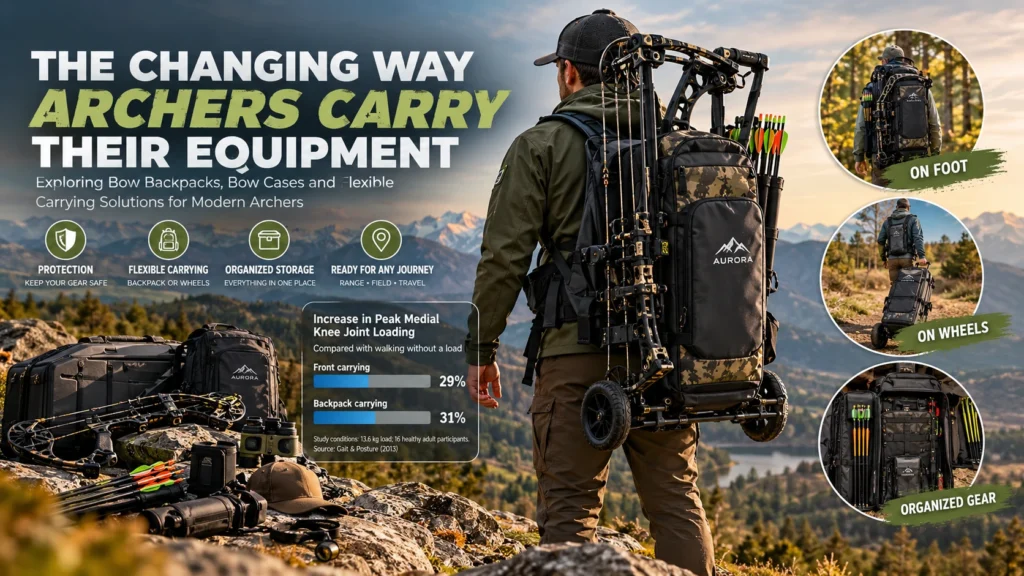
Archery involves much more than selecting a bow and developing accurate shooting techniques. Behind every practice session, training day, or competition is the preparation required to transport and organize equipment. From bows and arrows to quivers, protective accessories, and maintenance tools, archers often have several items to manage before reaching the shooting line.
As archery equipment becomes an important part of an archer’s regular routine, the way it is transported also deserves attention. Traditional bow cases, archery bags, and backpacks each offer different approaches to carrying equipment. However, not every transportation method is equally practical for every journey.
A Bow Backpack or alternative carrying arrangement can make equipment transportation more convenient, depending on the archer’s requirements. Products such as the AURORA Back Carrying System introduce another approach by combining the concept of back carrying with wheeled transportation.
Understanding the changing transportation needs of archers helps explain why carrying systems have become an important part of modern archery equipment.
Archery Equipment Involves More Than Just a Bow
When people think about archery equipment, the bow is usually the first item that comes to mind. However, a regular archer may need several additional items for practice, maintenance, and competition.
Depending on the discipline and individual setup, equipment can include:
- Compound or recurve bow
- Arrows and arrow containers
- Quiver and arrow accessories
- Arm guard and finger protection
- Bowstring and maintenance accessories
- Release aids and other shooting equipment
- Small tools and replacement components
Managing all these items requires some planning. Carrying everything separately can make preparation less convenient, while an unsuitable bag may not provide enough room or the right arrangement.
This is where an appropriate Archery Equipment Bag or carrying system becomes useful. Instead of thinking only about where the bow will fit, archers should consider how their complete equipment setup will be transported.
The right arrangement depends on equipment dimensions, storage requirements, carrying comfort, and the locations an archer regularly visits.
How Archers Transport Their Equipment Today
Archers travel to different environments throughout the year. Some regularly visit indoor shooting ranges, while others participate in outdoor practice sessions, tournaments, and field archery activities.
Each environment creates different transportation requirements. Carrying equipment through a building may involve stairs, corridors, and limited storage space. Outdoor locations may include grass, gravel, and uneven paths. Travelling to competitions may also require additional accessories and personal equipment.
A conventional Bow Case can be suitable for storing and protecting a bow, but transportation convenience depends on its design and weight. An Archery Backpack offers another approach, particularly when carrying equipment on foot is necessary.
Wheeled transportation introduces a different option. Rather than carrying the entire load continuously, an archer can move suitable equipment using wheels when the surrounding surface allows it.
These different requirements explain why modern archery transportation is not limited to one type of bag or case. The most practical option depends on the archer’s equipment and the journey involved.
Different Carrying Solutions for Archery Equipment
Archery transportation products come in several formats. Each serves a different purpose, and understanding their differences can help archers select a suitable arrangement.
Bow Cases and Protective Storage
A Bow Case is primarily designed to store and transport a bow. Depending on its construction, it may offer padding, compartments, and additional storage space.
Hard bow cases generally provide a more rigid external structure, while soft cases are often lighter and more flexible. A Compound Bow Case and a Recurve Bow Case may have different internal shapes because the bows themselves have different dimensions and designs.
When selecting a case, archers should consider internal dimensions, bow compatibility, padding, protective construction, accessory compartments, and carrying arrangements.
The purpose of a suitable bow case is not simply to hold equipment. It should also make storage and transportation practical for the intended use.
Archery Backpacks and Bow Bags
An Archery Backpack provides a carrying option that uses shoulder straps or a backpack-style arrangement. It can be useful for archers who regularly walk between transportation points and shooting locations.
A Bow Bag may offer a more flexible storage format, depending on its size and construction. Some models are designed to accommodate a particular bow type, while others provide space for additional accessories.
However, not every backpack is suitable for every bow. Archers should always check the manufacturer’s dimensions and compatibility information before choosing an archery bag.
The main advantage of a backpack-style arrangement is that it allows equipment to be carried on the back rather than held continuously by hand.
Wheeled Transportation
A wheeled bow case or equipment trolley can be useful when transporting heavier equipment over suitable surfaces.
This approach may be convenient in airports, large competition venues, and other locations with smooth pathways. However, wheels are not equally practical everywhere. Stairs, rough paths, narrow passages, and uneven ground can make wheeled transportation difficult.
For this reason, some archers may prefer a carrying solution that offers an alternative to relying entirely on wheels.
The Physical Side of Carrying Archery Equipment
Equipment weight and transportation methods can influence how people move. Carrying a load on the back, holding it in front, or pulling it using wheels can create different physical demands.
Research published in Gait & Posture in 2013 examined how carrying a 13.6 kg load affected knee joint loading during walking and stair movement. The study involved 16 healthy adults.
Compared with walking without a load, the researchers reported approximately 29% higher peak medial knee joint loading when carrying the load in front and approximately 31% higher loading when carrying it in a backpack.
The findings demonstrate that adding equipment weight can affect the physical demands of transportation. They do not mean that one particular archery carrying product causes the same effects, nor do they establish a universally best carrying method.
For archers, the practical takeaway is to consider the total equipment weight, the route, and the amount of time spent carrying the load.
Research Comparison: Carrying a Load During Walking
The following chart summarizes the reported increase in peak medial knee joint loading compared with unloaded walking.
Increase in Peak Medial Knee Joint Loading
Compared with walking without a load
Front carrying – 29%
Backpack carrying – 31%
Study conditions: 13.6 kg load; 16 healthy adult participants. Percentages represent reported increases, not the percentage of total body weight.
Another study published in Applied Ergonomics in 2019 compared backpack carrying with pulling a trolley among 49 schoolchildren. It found that trolley use required smaller gait adaptations than backpack carrying under the tested conditions. This research involved children carrying school loads, not adult archers, so its findings should be treated as general transportation context rather than direct evidence about archery equipment.
Together, these studies show why the transportation method and surrounding environment matter when selecting a carrying solution.
Why Flexible Transportation Options Matter to Archers
An archer’s transportation needs can change throughout a normal shooting routine. At one location, carrying equipment on the back may be more practical. At another, wheeled transportation may be easier because of the available walking surface and distance.
This is one reason flexible carrying arrangements are worth considering. A transportation solution should be evaluated according to several practical factors:
- Different walking environments: Archers may need to move through indoor corridors, outdoor paths, stairs, and competition venues.
- Equipment weight: A complete equipment setup can weigh more than the bow alone. The carrying method should suit the actual load.
- Accessibility: The arrangement should allow the archer to access and organize equipment without unnecessary difficulty.
- Storage requirements: Bow dimensions, accessories, and protective requirements should be considered before selecting a carrying solution.
- Travel routine: Someone who visits a nearby range may have different requirements from an archer who regularly travels to competitions.
These factors are more useful than assuming that one transportation product is automatically suitable for every archer.
Archers looking for a flexible way to transport their equipment can explore the AURORA Back Carrying System, which combines back carrying with wheeled transportation.
AURORA Back Carrying System and a Different Approach to Transportation
The AURORA Back Carrying System is an option for archers interested in an alternative approach to moving their equipment.
Its concept focuses on combining back carrying with wheeled transportation. This gives archers two transportation approaches to consider rather than relying exclusively on a conventional carrying arrangement.
Back carrying can be useful in situations where moving equipment on the back is more practical. Wheeled transportation offers another option when the route and surface make rolling more convenient.
This combination is relevant to archers who travel between different environments and want to consider how their equipment is moved throughout the journey.
Rather than treating the product as a replacement for every Bow Case or Archery Backpack, it is more useful to understand its role as a transportation solution.
Before purchasing, archers should review the product’s official specifications, compatibility requirements, attachment arrangement, and included components. These details help establish whether the system is suitable for their existing equipment.
Comparing Different Archery Equipment Transportation Options
The following comparison highlights the main differences between common carrying arrangements.
| Transportation Option | Main Function | Suitable Consideration |
|---|---|---|
| Bow Case | Bow storage and protection | Equipment protection and dimensions |
| Bow Backpack | Back carrying | Walking and hands-free transport |
| Bow Bag | Flexible equipment storage | Storage capacity and organization |
| Wheeled Bow Case | Rolling transportation | Smooth surfaces and heavier equipment |
| Archery Equipment Trolley | Moving equipment on wheels | Longer journeys across suitable pathways |
| AURORA Back Carrying System | Back carrying and wheeled transportation | Flexibility between transportation methods |
The best choice depends on the archer’s equipment and travel routine. A protective case may be the priority for one person, while another may place greater importance on carrying flexibility.
Keeping Archery Equipment Organized During Travel
Transportation is only one part of managing archery equipment. Organization also matters because small accessories can be misplaced or damaged when everything is stored together without a suitable arrangement.
A well-organized Archery Equipment Bag or storage setup can make preparation easier before a shooting session.
Here are some practical ways to organize equipment:
- Keep arrows in a suitable protective container.
- Store small accessories together where practical.
- Keep delicate bow components protected from unnecessary pressure.
- Check equipment before and after transportation.
- Separate maintenance tools from delicate shooting accessories.
- Store equipment in a clean, dry environment.
- Follow the care instructions provided by the equipment manufacturer.
Bow Storage should also be considered after returning from the range. Equipment should be removed, checked, and stored according to the manufacturer’s recommendations.
Good organization does not require the most expensive bag or case. It requires a carrying arrangement that matches the equipment and the way it is used.
What Archers Should Consider Before Choosing a Carrying System
Before investing in a new transportation solution, archers should assess their existing equipment and regular travel requirements.
First, identify the bow type and check whether the selected product is compatible with it. Recurve and compound bows have different shapes and may require different storage arrangements.
Second, consider how many accessories are normally transported. An archer carrying only a bow may need a different solution from someone travelling with arrows, a quiver, protective equipment, and maintenance tools.
Third, think about the travel environment. Smooth indoor surfaces, outdoor paths, stairs, and long walking distances can influence which transportation method is most practical.
Finally, review the product specifications. Dimensions, attachment requirements, weight capacity, carrying arrangements, and included components should all be checked before purchase.
These considerations help prevent choosing a product simply because its appearance or description sounds convenient.
Frequently Asked Questions
What is the difference between a Bow Backpack and a Bow Case?
A Bow Backpack focuses on carrying equipment using a backpack-style arrangement, while a Bow Case primarily provides a storage and protective enclosure. Some products combine storage and backpack-style transportation features.
Can an Archery Backpack carry compound and recurve bows?
Compatibility depends on the individual product. Compound and recurve bows have different dimensions and shapes, so archers should check the manufacturer’s specifications before purchasing.
What is the purpose of a Bow Bag?
A Bow Bag provides a way to store and transport a bow or selected archery accessories. Its capacity and protective features vary by model.
Why do archers use wheeled transportation?
Wheels can make moving equipment more convenient across smooth surfaces, especially when the equipment is heavy or the distance is long. However, wheels may be less practical on stairs and uneven paths.
What makes the AURORA Back Carrying System different?
The AURORA Back Carrying System focuses on back carrying and wheeled transportation, offering an alternative approach to moving archery equipment. Its suitability depends on the user’s equipment and the manufacturer’s compatibility specifications.
How should archery equipment be protected during travel?
Use a suitable case or compatible carrying arrangement, protect delicate components, organize accessories, and follow the manufacturer’s transportation and storage instructions.
What should archers check before buying a carrying system?
Archers should review compatibility, dimensions, carrying comfort, storage requirements, attachment arrangements, and the components included with the product.
Final Thoughts
The way archers transport their equipment is an important part of their overall shooting routine. Bow cases, Bow Backpacks, Bow Bags, and wheeled transportation products all address different needs.
As archers move between practice locations, outdoor environments, and competitions, flexibility and organization become important considerations. The right carrying arrangement should suit the equipment, the journey, and the individual archer’s preferences.
The AURORA Back Carrying System offers an alternative transportation concept by bringing back carrying and wheeled transportation together. For archers exploring different ways to move their equipment, it is worth considering alongside conventional archery carrying solutions.
Ultimately, a practical transportation setup is one that helps archers manage their equipment efficiently while fitting naturally into their regular archery routine.
Research References:
- Hall et al. (2013), Medial knee joint loading during stair ambulation and walking while carrying loads.
- Orantes-Gonzalez et al. (2019), A kinematic comparison of gait with a backpack versus a trolley for load carriage in children.
- Huang & Kuo (2014), Mechanics and energetics of load carriage during human walking.