

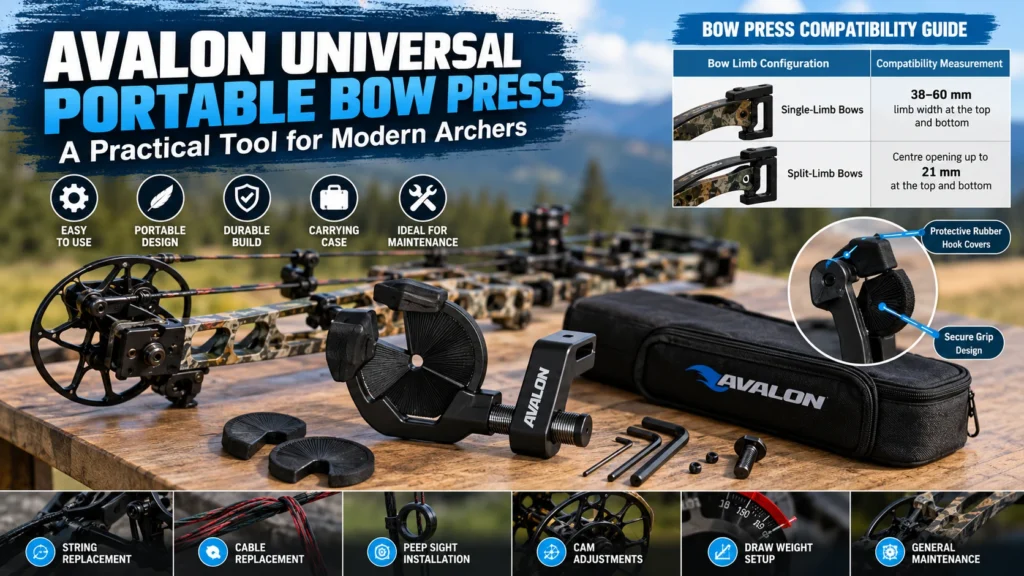
Compound archery equipment relies on several mechanical components working together. Bow limbs, cams, strings and cables all contribute to the way a compound bow operates. Keeping these components in suitable condition requires regular inspection and, when necessary, the correct maintenance equipment.
For archers who want to understand how compound bow maintenance works, a portable bow press is an important piece of equipment to consider. It is designed to support selected maintenance procedures, including compatible string and cable replacement and peep sight installation. However, choosing the right press involves more than looking at its size or portability. Bow construction, limb measurements and manufacturer-approved procedures all matter.
The Avalon Universal Portable Bow Press offers a compact option for selected compound bow maintenance requirements. Understanding its design, configurations and compatibility information helps archers evaluate where it may fit into their equipment setup.
Why Compound Bow Maintenance Requires the Right Equipment
A compound bow is a mechanical system in which several components work together throughout the draw and release cycle. The limbs store energy, while the cams, bowstring and cables control how that energy is transferred. Each component has a specific role, and a problem with one part can affect the overall setup.
Regular inspection helps identify visible wear, damage and changes that may require professional attention. For example, worn serving, damaged string strands, cable deterioration or unusual cam movement should not be ignored.
Different maintenance tasks also require different tools. A bow square can help check measurements around the string and arrow rest, while suitable Allen keys are used for compatible accessory adjustments. Procedures involving tensioned strings and cables may require a compatible bow press and a manufacturer-approved method.
Common compound bow maintenance considerations include:
- Inspecting bowstrings and cables for visible wear or damage.
- Checking serving condition and peep sight position.
- Reviewing cam timing and cam alignment.
- Checking arrow rest position and centre shot.
- Monitoring draw weight and draw length settings.
- Replacing worn components using an approved service procedure.
The important point is that maintenance should be based on the actual bow and its specifications. Not every adjustment requires a bow press, and not every compound bow can be serviced using the same pressing method.
Where a Portable Bow Press Fits into an Archer’s Equipment Setup
A portable bow press is a specialised tool used to manage string and cable tension during certain approved compound bow maintenance procedures. Depending on the bow design and the manufacturer’s instructions, it can provide access for tasks such as string replacement, cable replacement and selected peep sight work.
Portable designs are generally intended to offer a more compact alternative to larger workshop equipment. This can be useful for archers who want to store their maintenance tools conveniently or transport them between locations.
However, portability should not be confused with universal compatibility. Compound bows have different limb structures, widths and pressing requirements. A press that is suitable for one bow may not be approved for another.
Before choosing a portable bow press, archers should consider:
- The construction of the bow limbs.
- The width of the upper and lower limbs.
- The centre opening on split-limb bows.
- The press contact points and configuration.
- The manufacturer’s approved pressing method.
- The maintenance task that needs to be performed.
These checks help determine whether a portable press is appropriate for the intended application.
How Bow Components Influence Maintenance Decisions
Understanding the relationship between compound bow components helps explain why some maintenance procedures require specialist equipment. A bow should be assessed as a complete mechanical system rather than a collection of unrelated accessories.
Bow String and Cable Condition
The bowstring and cables are central to the operation of a compound bow. They work with the cams and limbs to control movement during the draw cycle. Regular use can lead to serving wear, visible strand damage or other signs that inspection is needed.
String and cable replacement must use components that meet the bow manufacturer’s specifications. The correct procedure may require a suitable bow press to manage tension. A portable press can support this work only when the particular bow is approved for that press design and method.
Cam Timing and Bow Timing
Cam timing describes the relationship between the cams as they rotate during the draw cycle. On compound bows with two cams, their movement must follow the manufacturer’s intended specifications.
If cam timing is incorrect, the bow may not operate as designed. Archery technicians may use a draw board or other suitable inspection equipment to assess cam movement. Depending on the bow design, correcting a timing issue may involve cable adjustments that require an approved bow press.
Cam Lean and Cable Alignment
Cam lean refers to sideways tilt of a cam relative to its intended alignment. The bow’s design, cable routing and manufacturer specifications all matter when assessing cam position.
It is not appropriate to assume that every visible angle is a fault because different compound bow designs have different alignment characteristics. If a technician identifies an issue, any correction must follow the manufacturer’s instructions and approved maintenance procedure.
Peep Sight Position and String Setup
A peep sight is positioned within the bowstring to provide an aiming reference. Its position should allow the archer to achieve a consistent sight picture at the normal anchor position.
If the peep sight rotates or sits incorrectly, the string setup may need inspection. Some installation or repositioning procedures require the string to be relaxed. A compatible bow press may provide access for this work, depending on the bow manufacturer’s approved method.
How Different Maintenance Checks Work Together
Compound bow maintenance is more effective when checks are performed in a logical order. Cam timing, cam lean, centre shot, paper tuning, sight alignment and walk-back tuning are related topics, but they are not interchangeable procedures.
A mechanical inspection can help identify issues with the bow itself. Shooting-based tuning checks can then help evaluate arrow flight and equipment alignment. A bow press belongs in the mechanical maintenance stage when an approved procedure requires it; it does not replace the complete tuning process.
A Connected Approach to Bow Inspection and Tuning
The following workflow shows how common inspection and tuning activities can be organized. It is a conceptual overview, not a substitute for the bow manufacturer’s service instructions.
-
Initial Equipment Inspection
Check bow limbs, cams, strings, cables and accessories for visible wear or damage.
-
Mechanical Setup Checks
Review cam timing, cam lean, bow timing and cable condition according to the bow manufacturer’s specifications.
-
Specialist Maintenance, If Required
Use a compatible bow press for approved string replacement, cable replacement or peep sight work.
-
Arrow and Rest Alignment
Check centre shot, nocking point and arrow rest position using suitable archery tools.
-
Shooting-Based Tuning Checks
Perform appropriate paper tuning, walk-back tuning and sight alignment checks.
-
Final Inspection and Records
Confirm the equipment settings and record any maintenance or adjustments performed.
Note: This is a conceptual maintenance workflow. Always follow the exact procedures and compatibility requirements specified by the bow manufacturer.
This workflow highlights an important distinction: a bow press is not needed at every stage of tuning. Paper tuning, walk-back tuning and sight alignment are shooting-based checks that use different methods. A press may be required before or during certain mechanical adjustments, but it does not independently confirm that a bow is correctly tuned.
What Makes the Avalon Universal Portable Bow Press a Practical Option?
For archers considering a portable maintenance tool, the Avalon Universal Portable Bow Press is designed for selected compound bow maintenance tasks. Its product configuration, compatibility measurements and included accessories are useful details to review when comparing portable bow press options.
Compact and Portable Construction
A compact design can make equipment easier to store and transport. The Avalon press is described as lightweight and portable, which may suit archers who prefer to keep their maintenance tools organized in a carrying case.
This type of design can be useful when storage space is limited or equipment needs to be moved between locations. However, the decision to use a portable press should always be based on compatibility and the manufacturer’s instructions rather than convenience alone.
Support for Selected String and Cable Work
String and cable replacement are among the listed uses of the product. These jobs require the correct replacement components and an approved pressing method.
The press should not be used on a bow simply because the limbs appear to fit. The bow manufacturer’s compatibility requirements remain the deciding factor.
Included Carrying Case and Rubber Hook Covers
The product package includes a soft protective carrying case and spare rubber hook covers. The case helps keep the equipment together during storage and transport, while the additional covers are useful accessories to consider when reviewing the package.
These included items do not remove the need to inspect the press and its contact points before use. Equipment should always be checked before a maintenance procedure begins.
Checking Bow Press Compatibility Before Choosing a Model
Compatibility is one of the most important considerations when selecting a portable bow press. Compound bows can have different limb widths, split-limb openings and structural designs. The pressing method approved for one model may not be suitable for another.
The Avalon product information lists the following measurements:
| Bow Construction | Listed Measurement | What to Check |
|---|---|---|
| Single-limb bows | 38–60 mm limb width at top and bottom | Measure both upper and lower limb areas. |
| Split-limb bows | Centre opening up to 21 mm at top and bottom | Check the opening at both ends and confirm the approved contact arrangement. |
The product is listed in three configurations:
- Standard
- Top Medium / Lower Wide
- Top Medium / Lower Medium
These configurations reflect differences in the upper and lower limb contact requirements. Archers should compare their bow with the exact configuration details before making a selection.
These measurements are product compatibility information, not a guarantee that every bow within those dimensions can be pressed safely. Manufacturer restrictions, limb shape, contact points and the approved pressing method must also be considered.
Portable Bow Press Compared with Workshop Equipment
Portable and workshop bow presses are designed for related maintenance purposes, but their size, construction and intended working environments can differ. A portable model may be convenient for selected tasks, while a workshop press may be more suitable for a technician who regularly services different bow models.
| Comparison Factor | Portable Bow Press | Workshop Bow Press |
|---|---|---|
| Physical format | Compact and easier to transport | Usually larger and designed for a fixed work area |
| Storage | May be stored in a dedicated carrying case | May require dedicated workshop space |
| Typical role | Selected maintenance tasks on compatible bows | Regular service work, depending on press design |
| Compatibility checks | Required before every intended application | Also required; workshop equipment is not automatically universal |
| Suitable user | Archers seeking a portable maintenance option | Archery technicians and service workshops |
The best choice depends on the type of bow being maintained and the work being performed. A larger press is not automatically suitable for every compound bow, just as a portable press is not automatically suitable for every workshop adjustment.
Other Archery Tools That Support a Consistent Bow Setup
A bow press is only one part of a compound bow maintenance setup. Other tools help with measurements, inspection and shooting-based tuning. Using the correct tool for each task reduces the temptation to make adjustments without understanding the underlying issue.
- Bow square: Helps check nocking point and related string measurements.
- Allen keys: Used for compatible accessory and hardware adjustments.
- Draw board: Helps a technician observe the draw cycle and assess cam timing.
- Paper tuning frame: Provides a way to inspect arrow tears during a controlled tuning test.
- Bow level: Supports alignment checks for sights and other equipment.
- Arrow rest tools: Help with suitable rest positioning and centre shot adjustments.
- Bow press: Supports approved procedures that require string or cable tension to be managed.
These tools have different purposes. Paper tuning can help identify an arrow-flight issue, but it does not diagnose every possible mechanical problem. Similarly, a bow press can provide access for selected maintenance work, but it does not independently confirm that the bow is correctly tuned.
Safety Considerations During Compound Bow Maintenance
Compound bow limbs, strings and cables store energy. Incorrect handling can damage equipment and cause injury. A portable bow press should only be used when the bow manufacturer permits the pressing method and the press instructions are followed.
Before any maintenance procedure, check the bow manual, inspect the press and confirm the contact points. Do not force a press onto a bow that does not fit correctly. Stop if the equipment shifts, makes an unusual movement or appears to place pressure on an unapproved area.
Some manufacturers restrict the use of certain portable presses or require a specific press design. If the correct method is uncertain, consult the manufacturer or a qualified archery technician. Complex cam timing, cable adjustments and limb-related work should not be attempted based only on a general online explanation.
Keeping Archery Equipment Ready for Regular Use
Good equipment care is an ongoing process. Archers should inspect strings, cables, serving, cams, limbs and accessories at sensible intervals and whenever they notice a change in how the bow feels or performs. Visible damage should be assessed before the bow is used again.
It is also useful to keep a record of important setup measurements and service work. Notes about draw weight, draw length, brace height, string changes and other relevant settings can help identify differences over time.
After a string or cable replacement, the bow may need its specifications and tuning checked again according to the manufacturer’s instructions. Consistent inspection does not mean making frequent adjustments without a reason. It means understanding the equipment, noticing changes and using suitable tools or professional support when maintenance is needed.
Frequently Asked Questions
What is the Avalon Universal Portable Bow Press used for?
It is designed to support selected compound bow maintenance tasks, including compatible string and cable replacement, peep sight installation and certain adjustments. Its use depends on the bow’s compatibility and the manufacturer’s approved pressing method.
Can a portable bow press fit every compound bow?
No. Compound bows have different limb designs and pressing requirements. Check the bow’s measurements, the press configuration and the manufacturer’s instructions before use.
What are the Avalon bow press compatibility measurements?
The listed measurements are 38–60 mm limb width at the top and bottom for single-limb bows, and a centre opening up to 21 mm at the top and bottom for split-limb bows. These measurements do not replace the full compatibility check.
Does the Avalon portable bow press include a carrying case?
Yes. The listed package includes a soft protective carrying case and spare rubber hook covers. Check the current product listing for the exact package contents.
Is a bow press needed for paper tuning?
Paper tuning is a shooting-based method used to examine the tear made by an arrow passing through paper. It does not normally require a bow press. A press may be needed separately if a mechanical adjustment is required to address an identified issue.
What is the difference between cam timing and cam lean?
Cam timing describes the relationship between cam rotation during the draw cycle. Cam lean describes sideways tilt of a cam relative to its intended alignment. Both should be assessed against the bow manufacturer’s specifications.
Can beginners use the Avalon Universal Portable Bow Press?
Beginners should first confirm compatibility and understand the manufacturer’s instructions. Anyone unfamiliar with compound bow maintenance should seek help from a qualified technician rather than attempting string, cable or cam adjustments independently.
Final Thoughts
Maintaining a compound bow involves understanding how its strings, cables, cams, limbs and accessories work together. Tools such as a portable bow press can support selected maintenance procedures, but they must be matched to the bow and used according to approved instructions.
The Avalon Universal Portable Bow Press offers a compact option for archers considering portable equipment for compatible string, cable and peep sight work. Its listed limb measurements, three configurations, protective carrying case and spare rubber hook covers are useful details to review when evaluating the product.
Ultimately, the right maintenance decision starts with compatibility, correct equipment and safe working practices. When a procedure is outside the press’s approved use or the bow manufacturer’s instructions are unclear, professional archery service is the sensible choice.