

Finding the Balance Between Power, Precision and Control in Archery
Modern archery is a sport where small details can make a meaningful difference to the overall shooting experience. An archer must coordinate posture, strength, aiming, equipment positioning and release timing while maintaining control of the bow. Although the equipment may look straightforward, every component contributes to how the bow feels and responds throughout a shot.
As archers develop their technique, they often become more aware of balance and weight distribution. A bow that feels comfortable during the initial setup may respond differently when additional accessories are installed. Sights, arrow rests, quivers and other components can change the way weight is distributed across the riser. This is one reason stabilizing equipment has become an important part of many modern target archery setups.
An Archery Stabilizer Kit brings together components that can help an archer configure bow balance and handling. However, its importance goes beyond adding weight to a bow. Stabilizer bars, side rods and adjustable weights influence how the equipment responds to movement, making the relationship between the archer and the bow an interesting part of modern archery.
The Relationship Between an Archer and Their Equipment
Every archer develops a personal relationship with their equipment. Some prefer a lightweight configuration that is easy to handle, while others feel more comfortable with a carefully balanced setup containing several stabilizing components. Neither approach is automatically better because individual strength, shooting style and equipment preferences vary.
The way a bow feels at full draw is particularly important. During aiming, an archer must maintain a controlled position while managing natural movement in the body and bow. A setup that feels uncomfortable or excessively heavy may make this process more demanding, especially during extended practice sessions.
This is where equipment balance becomes relevant. Instead of focusing only on the weight of individual accessories, archers can consider how the complete setup behaves. The position of a front bar, the angle of side rods and the distribution of additional weights can all influence the overall handling experience.
Why Balance Is More Than Just the Weight of a Bow
Balance is not simply about making a bow heavier or lighter. It is about how mass is distributed around the equipment and how that distribution influences movement. Two bows with similar total weights can feel noticeably different if their accessories are positioned differently.
For example, placing weight farther forward changes the bow’s response compared with keeping the same weight close to the riser. Similarly, a side-mounted accessory can influence lateral balance in a way that a front-mounted component does not.
These differences explain why Archery Stabilizers are available in different lengths and configurations. Their purpose is not to create a completely motionless bow. Instead, they provide additional control over weight distribution and resistance to certain movements.
How Stabilizer Bars Influence Bow Movement
A stabilizer bar extends away from the bow’s central mounting point. Depending on its position and length, it changes how the equipment responds to movement and rotational forces. The amount of weight attached to the bar also influences its behaviour.
A longer bar places its end weight farther from the bow. This changes rotational resistance, which is one reason stabilizer length and weight are considered together rather than independently. A small amount of weight positioned farther away can have a different mechanical effect from the same amount positioned close to the riser.
For target archers, this can be relevant when developing a configuration that feels controlled during aiming. However, a longer stabilizer is not automatically the right choice. Handling comfort, total weight, shooting discipline and individual technique all matter.
Front Stabilizers, Side Rods and the Changing Shape of Bow Setups
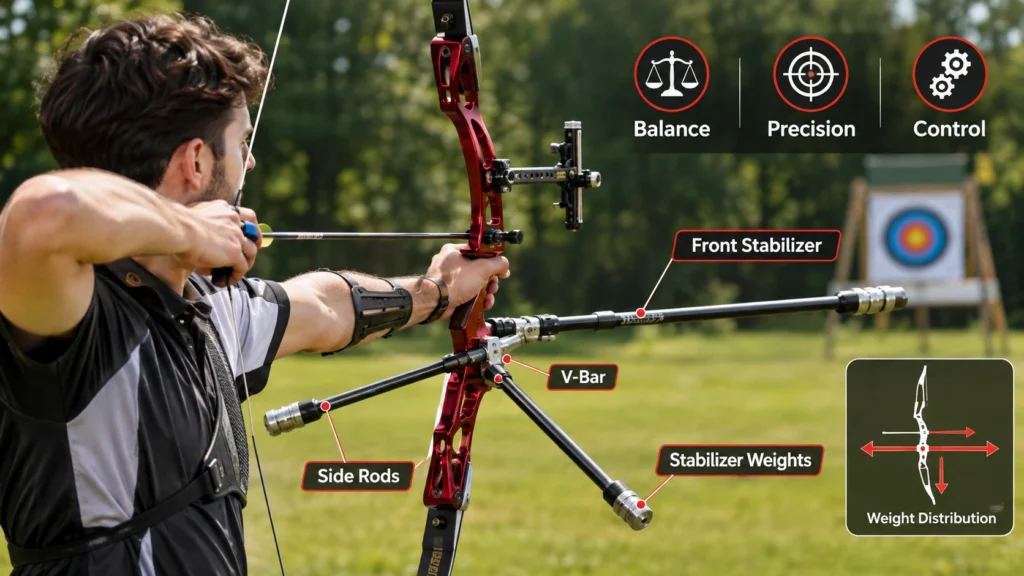
Modern target bows can have several accessories extending from different mounting positions. A front stabilizer is generally attached to the front of the riser, while side rods extend at an angle through compatible mounting hardware. Together, these components provide additional ways to distribute weight around the bow.
The Role of Front Stabilizers
A front stabilizer extends forward from the bow and usually carries additional weight near its outer end. Its position influences forward weight distribution and resistance to certain movements. The length and weight configuration can vary according to the archer’s preferences and shooting discipline.
Some archers prefer a relatively simple front-bar arrangement, while others use longer stabilizers as part of a more developed target setup. The important consideration is how the complete bow feels during normal shooting rather than how impressive the equipment looks.
Why Side Rods and Back Bars Matter
Side rods provide another way to manage the balance of a bow. They are often positioned using a compatible V-bar or mounting bracket. Their angle and weight can influence how the bow feels from side to side.
A sight, quiver and other accessories may create an uneven distribution of mass. Side rods can provide additional adjustment options when an archer wants to manage this imbalance. A back bar can also form part of a multi-rod configuration, depending on the intended setup.
For many target archers, a front stabilizer combined with side rods creates a familiar multi-directional configuration. These arrangements demonstrate why an Archery Stabilizer Set can be more than a collection of separate bars. The components work together as a system, and changing one position may influence the overall feel of the bow.
Why Weight Distribution Deserves More Attention
Archery Stabilizer Weights allow archers to adjust the mass attached to different parts of a stabilizer system. These weights may be positioned at the end of a front bar or side rod, depending on the design and compatibility of the equipment.
Adding weight farther from the riser changes rotational resistance. However, increasing weight also changes the physical demands of holding and controlling the bow. A configuration that feels comfortable for a short session may become tiring during a longer training routine.
For this reason, adjustments are generally more useful when made gradually. An archer can evaluate the current setup, make a small change and observe whether the new arrangement feels more manageable. Changing several components simultaneously can make it difficult to understand which adjustment influenced the result.
The objective is to find a balance between stability, control and comfort. More weight is not necessarily better, and an effective configuration should support the archer’s technique rather than create additional physical demands.
What Research Reveals About Bow Stability and Shooting Performance
Research in archery biomechanics provides useful insight into the relationship between the archer’s body movement and bow stability. One study published in the European Journal of Sport Science examined recurve archers during the aiming phase. Researchers measured bow movement and the movement of the archer’s centre of pressure while participants shot at a target.
The study found that bow displacement and body sway measurements were higher during the lowest-scoring shot compared with the highest-scoring shot. It also identified relationships between certain body movements and bow displacement. These findings suggest that the coordination of archer and bow movement is relevant to shooting performance.
Importantly, this research did not test a specific commercial stabilizer kit or establish a universal accuracy improvement percentage from using stabilizers. Its value is in showing why body balance and bow stability deserve attention when studying archery performance.
Research Chart: Body Movement and Bow Stability
Study: Research examining the relationship between bow stability and postural control in recurve archery.
Research comparison: The study reported higher movement measurements for the lowest-scoring shot than for the highest-scoring shot.
| Research Measure | Lowest-Scoring Shot | Highest-Scoring Shot |
|---|---|---|
| Across-target centre of pressure displacement | Higher | Lower |
| Centre of pressure trajectory length | Higher | Lower |
| Bow trajectory length | Higher | Lower |
Visual research comparison (qualitative, not to scale):
Lowest-scoring shot — reported movement
Body movement: Higher
Bow movement: Higher
████████████
Highest-scoring shot — reported movement
Body movement: Lower
Bow movement: Lower
██████
How to interpret this chart: The bars communicate the direction of the reported differences, not measured numerical magnitudes. They are a qualitative research illustration, not a percentage comparison or a measured performance improvement.
The research supports the importance of coordinating body balance and bow stability. It does not prove that adding a particular amount of stabilizer weight will automatically improve an archer’s score.
Different Configurations for Different Archery Preferences
There is no single stabilizer arrangement that suits every archer. Target recurve, compound and other shooting disciplines can have different equipment requirements. Even within the same discipline, archers may prefer different bar lengths, angles and weight distributions.
Some configurations focus on a front stabilizer, while others include side rods and additional mounting hardware. A more complete arrangement can provide more adjustment options, but it also increases total equipment weight and may require additional setup time.
When comparing Stabilizers for Archery, it is useful to consider the complete configuration rather than judging a system by the number of components it includes.
Comparing Common Archery Stabilizer Configurations
The following table highlights the differences between common arrangements and the considerations associated with each. It is a general equipment comparison, not a specification comparison of individual products.
| Configuration | Primary Role | Main Consideration |
|---|---|---|
| Front Stabilizer | Influences forward weight distribution and rotational resistance | Bar length and end weight |
| Side Rods | Provide additional lateral balance options | Mounting angle and weight position |
| Back Bar | Offers another option for managing bow balance | Compatibility and overall handling |
| Multi-Rod Stabilizer Set | Combines front and side stabilizing components | Total weight and configuration |
| Stabilizer with Dampening | Combines stabilizing weight with vibration-management features | Construction and damping design |
American and British Archery Equipment Terminology
Archery equipment searches often use different spelling depending on the region. American websites commonly use Archery Stabilizer Set and Archery Stabilizers, while British and some European websites use Archery Stabiliser Set and Archery Stabilisers.
Both spelling variations refer to the same general category of equipment. The word stabilizer is common in American English, while stabiliser is the British English form. This distinction is useful when researching equipment from international manufacturers and retailers.
Other searches, including Archery Bow Stabilizer and Stabilizer Bar Archery, can refer to individual components rather than a complete kit. Understanding these terms makes it easier to compare the right equipment and avoid confusing a single front bar with a multi-component arrangement.
How Equipment Compatibility Influences the Final Setup
Compatibility should always be considered before selecting a stabilizer system. Mounting threads, attachment hardware and the design of the bow riser can affect which components can be installed. A stabilizer that appears suitable in a photograph may not necessarily fit a particular bow.
It is also worth considering the accessories already attached to the equipment. A sight, quiver and other components can influence weight distribution. The stabilizer arrangement should be evaluated alongside these accessories rather than as an isolated purchase.
Manufacturer specifications provide the most reliable starting point. Checking the included components, mounting requirements, weight options and construction details can help avoid unnecessary adjustments after installation.
When a More Complete Stabilizer Setup Makes Sense
A multi-component configuration can be useful for archers who want more control over the distribution of weight around their bow. A front bar and side rods provide different adjustment positions, allowing the overall setup to be configured according to personal preferences.
For archers comparing a complete Archery Stabilizer Kit, useful considerations include the available long and short rod lengths, extender options, adjustable mounting hardware, damping components and included weights. These features can provide flexibility when configuring a compatible bow setup. The actual suitability still depends on the archer’s equipment and preferred balance.
However, a complete setup is not automatically necessary for every archer. Someone who prefers a simple bow arrangement may not need additional rods, while a target archer who regularly experiments with balance may appreciate the flexibility of a more developed system.
The decision should be based on shooting requirements, compatibility and comfort. An Archery Stabilizer Kit is best considered as part of a complete equipment configuration rather than a guaranteed shortcut to better shooting performance.
Why Balance and Consistency Remain Important in Modern Archery
Archery equipment continues to develop, but the relationship between the archer and the bow remains central to the sport. Modern accessories provide more opportunities to adjust weight distribution, manage vibration and personalise equipment handling.
Front stabilizers, side rods, back bars and adjustable weights each contribute differently to a complete setup. Understanding their functions allows archers to make more informed decisions and avoid adding equipment without a clear reason.
Research into bow stability and postural control also demonstrates that shooting performance involves several connected factors. Equipment configuration matters, but it works alongside physical control, repeatable technique and consistent practice.
Final Thoughts
Finding the right balance in archery is a process of understanding how equipment and technique work together. The distribution of weight, position of stabilizer bars and use of additional components can influence how a bow feels and responds during shooting.
An Archery Stabilizer Kit offers a way to explore these configurations through front stabilizers, side rods and adjustable weights. Whether an archer prefers a simple arrangement or a more complete Archery Stabilizer Set, the most important consideration is how well the equipment supports the intended shooting style.
Ultimately, consistent performance comes from a combination of suitable equipment, comfortable balance and structured practice. The most effective setup is not necessarily the heaviest or most complicated one, but the one that allows the archer to maintain control with confidence.