

The Role of Precision and Consistency in Modern Recurve Archery
Modern recurve archery is built around a combination of technique, concentration, equipment control, and repeatable movement. Every shot involves several connected actions, from raising the bow and establishing the anchor position to aiming, releasing, and maintaining follow-through. Although these movements may look simple when performed by an experienced archer, small differences throughout the shooting sequence can influence the final result.
As archers develop their technique, they often begin paying closer attention to equipment details that support consistency. Bow setup, arrow specifications, draw length, stabilisation, and release timing all contribute to the overall shooting experience. Even relatively small accessories can become important when they provide useful feedback during a familiar shooting routine.
Archery Clickers are one example of equipment designed around this principle. Commonly used in target recurve archery, they provide an audible indication when an arrow reaches a selected draw-length position. Their role is closely connected to timing and repeatability, two important considerations in modern recurve shooting.
Why Consistency Has Become Such an Important Part of Recurve Archery
Accuracy in archery is not simply about aiming at the centre of a target. An archer must reproduce a sequence of movements while managing posture, bow alignment, drawing force, and release timing. If one part of this sequence changes significantly between shots, the resulting performance may also become less predictable.
Consistency starts with the archer’s physical position. Foot placement, shoulder alignment, bow-arm stability, and anchor position all contribute to a repeatable shooting foundation. Equipment should support this process rather than encourage the archer to compensate for an unsuitable setup.
Experienced recurve archers often develop a familiar rhythm. They raise the bow, establish their position, draw smoothly, settle into the aiming phase, and complete the shot through a controlled release and follow-through. Repeating this sequence allows them to recognise small differences in movement and make adjustments through structured practice.
This is also why equipment selection should be considered as part of the complete shooting system. A suitable accessory may provide useful feedback, but it cannot replace proper technique, coaching, or consistent training.
How Small Equipment Details Influence the Shooting Experience
Archery equipment is made up of several components that work together. The riser provides the central structure, limbs store and release energy, the string transfers that energy to the arrow, and accessories help the archer manage different aspects of the shooting process.
Some accessories influence balance and stability, while others provide information about the archer’s position or movement. These differences explain why two pieces of equipment that appear relatively small can serve very different purposes.
For example, stabilisation equipment helps manage bow movement, while a clicker provides an audible reference associated with draw length. Neither component performs the same function, but both can contribute to a more organised shooting routine when selected and configured appropriately.
Small design details can also influence practical use. Mounting position, adjustment range, construction quality, and compatibility with the existing bow setup should all be considered. An accessory that does not fit correctly may create unnecessary complications instead of supporting the intended technique.
The Connection Between Draw Length and Repeatable Shooting
Draw length is an important part of recurve bow setup because it influences how the archer reaches their shooting position and manages the bow’s stored energy. A repeatable draw length helps establish a familiar relationship between the archer’s body position, arrow placement, and shooting sequence.
When an archer repeatedly reaches different draw positions, the shooting experience can become less predictable. Changes in posture, anchor position, and expansion may affect the way the bow is handled. This is one reason why coaches often pay attention to the archer’s final drawing movement during technique development.
Draw length should not be treated as a number that can be changed casually. It is connected to the archer’s physical proportions, bow configuration, arrow specifications, and established shooting technique. Any significant adjustment should be evaluated carefully, preferably with guidance from a qualified coach.
Equipment that provides a consistent reference can help an archer recognise when the intended position has been reached. However, the reference must be established around a comfortable and repeatable movement rather than forcing the body into an unsuitable position.
The Role of Archery Clickers in Modern Recurve Shooting
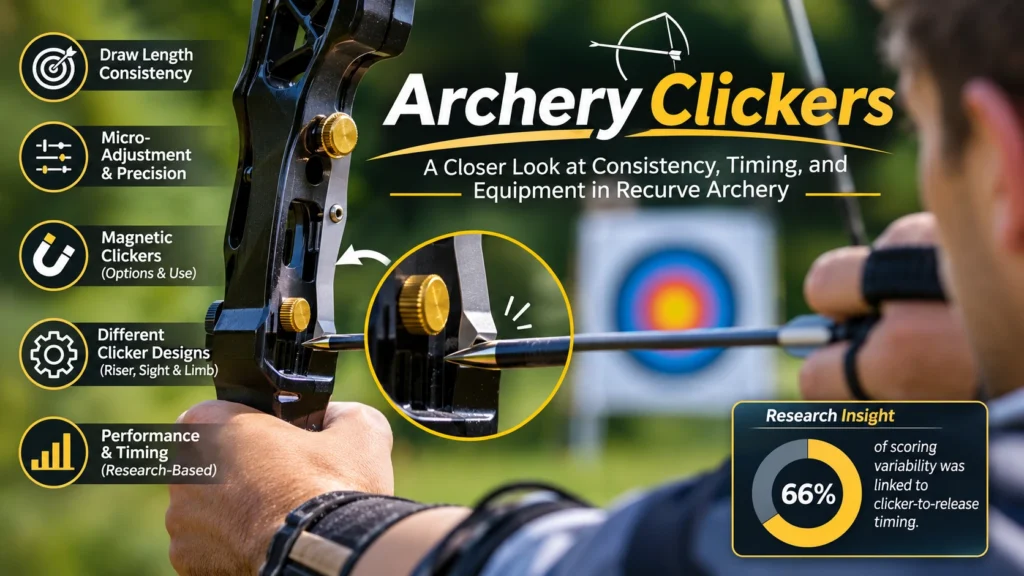
Archery Clickers are commonly used by target recurve archers to provide an audible signal associated with reaching a selected draw length. A conventional design generally uses a thin spring-steel blade positioned over the arrow. As the archer draws, the arrow moves underneath the blade until its point passes the selected position.
When the arrow point clears the blade, the clicker moves back against the bow and produces a clicking sound. This signal tells the archer that the intended draw-length reference has been reached.
The purpose is not to make the archer release without thinking. Instead, the sound becomes part of a familiar shooting sequence. The archer can use it as a timing reference while maintaining appropriate alignment, controlled expansion, and follow-through.
Different archers may incorporate this signal into their routine in slightly different ways. Their timing, aiming duration, and final movement can vary according to individual technique. What matters is that the equipment supports a controlled process rather than encouraging rushed or forced movement.
Why Timing Matters During the Final Stage of a Shot
The period between reaching the intended draw position and releasing the arrow is an important part of the shooting sequence. An archer must coordinate the final movement while maintaining appropriate posture and bow control. The relationship between the audible click and the subsequent release is therefore relevant to performance research.
A study published in Procedia Engineering in 2012 examined seven highly skilled archers performing 30 shots each at an indoor distance of 18 metres. Researchers developed an acoustic measurement system to identify the timing of the click, arrow release, and target impact.
The study reported that variation in clicker-to-release timing accounted for 66% of scoring variability within its statistical model. This finding highlights the importance of consistent timing in the small group examined. It should not be interpreted as proof that a clicker independently improves accuracy by 66%, or that the same percentage applies to every archer.
Research Chart: Clicker Timing and Scoring Variability
| Research Measure | Reported Result |
|---|---|
| Variation in clicker-to-release timing accounted for in the study’s scoring model | 66% |
| Participants | 7 highly skilled archers |
| Total shots analysed | 210 |
| Shooting distance | 18 metres |
Visual representation of the reported result:
Clicker-to-release timing contribution in the study model: 66%
█████████████░░░░░░░
Study sample: 7 archers, 210 shots.
Interpretation: The research identified a relationship between the consistency of clicker-to-release timing and scoring outcomes in the participants studied. The result illustrates why timing deserves attention in recurve archery, but it is not a universal performance benchmark.
Different Approaches to Clicker Design and Positioning
Not every archery clicker uses the same attachment arrangement. Different designs are intended to accommodate different bow configurations and equipment preferences. Understanding these differences helps explain why mounting compatibility and adjustment options matter.
Riser-Mounted Designs
Riser-mounted clickers attach directly to a compatible bow riser. A supporting arm positions the blade above the arrow, allowing the arrow point to move underneath it during the draw. This arrangement is widely associated with target recurve setups.
The available positioning range depends on the design and the mounting points provided by the bow. A suitable installation should keep the blade secure and allow the archer to establish the intended draw-length reference.
Sight-Mounted Designs
Sight-mounted clickers attach to a compatible sight assembly. This arrangement can provide an alternative positioning option for archers whose equipment supports this type of installation.
Compatibility should be checked before selecting this arrangement. The dimensions, mounting hardware, and adjustment range can differ between products, so assumptions based on appearance alone are not reliable.
Limb-Mounted Designs
Limb-mounted systems use a different attachment approach, with the mechanism positioned near a bow limb. Their construction and installation requirements differ from conventional riser-mounted designs.
Archers considering this type should review the manufacturer’s instructions to understand the intended mounting method and confirm that the design is appropriate for their equipment.
Micro-Adjustment and the Importance of Precise Positioning
Equipment adjustment is not always about making large changes. In some situations, small positional differences can be important when establishing a repeatable setup. This is where micro-adjustment features can become useful.
A micro-adjustable clicker allows controlled positional changes through a dedicated adjustment mechanism. Rather than relying entirely on larger manual movements, an archer can make smaller changes while observing how the arrow interacts with the blade.
For archers comparing equipment options, Archery Clickers with micro-adjustment features may be worth examining when precise positioning is an important part of their bow setup.
This can be relevant when fine-tuning a compatible setup or checking the relationship between arrow length, anchor position, and the clicker’s release point. The aim is to establish a suitable setting that works with the archer’s natural shooting technique.
Micro-adjustment should not become a reason to change the equipment after every inconsistent shot. Before moving the setting, an archer should consider whether the difference comes from technique, posture, fatigue, arrow specifications, or the actual equipment position.
When used thoughtfully, precise adjustment can make equipment setup more manageable. It is most useful when the archer understands the intended position and can evaluate changes through consistent practice.
How Different Shooting Habits Influence Equipment Preferences
Archers do not all approach the shooting process in exactly the same way. Some prefer a simple equipment arrangement with minimal adjustment, while others value additional positioning flexibility. These preferences can develop through experience, coaching, and changes in shooting requirements.
For example, an archer who uses a consistent arrow setup may prefer to establish a suitable position and leave it unchanged for an extended period. Another archer who regularly reviews equipment configuration may value an adjustment mechanism that allows smaller positional changes.
This does not mean one approach is automatically better. Equipment should match the archer’s actual requirements and remain compatible with the bow. A more complicated accessory is not necessarily more suitable if its additional features are unnecessary for the intended use.
When researching different archery clickers, it is useful to look beyond product appearance. Mounting design, blade construction, adjustment method, and manufacturer specifications provide more meaningful information about how an accessory may fit into an existing setup.
Comparing Different Archery Clicker Designs
The following comparison outlines common design approaches and the main considerations associated with each. Actual features vary by manufacturer and model, so product specifications should always be checked before purchase.
| Design Type | Typical Mounting | Main Consideration | Practical Focus |
|---|---|---|---|
| Standard Riser-Mounted Clicker | Bow riser | Direct attachment to a compatible riser | Conventional target recurve setup |
| Sight-Mounted Clicker | Bow sight assembly | Requires compatible sight hardware | Alternative positioning arrangement |
| Limb-Mounted Clicker | Bow limb area | Different attachment and installation method | Specific bow configurations |
| Micro-Adjustable Clicker | Depends on mounting design | Controlled fine positional changes | Detailed setup adjustments |
| Magnetic Clicker Design | Depends on the particular model | Actual mechanism and compatibility must be verified | Alternative design considerations |
Searches for Archery Magnetic Clickers and different archery magnetic clickers reflect interest in alternative mechanisms. However, the term magnetic should only be applied to a product when its manufacturer confirms that it uses a magnetic operating system. A conventional spring-blade clicker should not automatically be described as magnetic.
Why Equipment Compatibility Matters More Than Appearance
Archery accessories are often compared through photographs, product descriptions, and visible construction details. While these details can help narrow down options, compatibility is more important than appearance alone.
A clicker must be suitable for the intended mounting position and should provide the necessary clearance for the arrow. The blade should operate reliably, and the attachment should remain secure during normal use.
Arrow specifications also deserve attention. Changes in arrow length or point configuration can influence how the arrow sits relative to the clicker. Before adjusting equipment, archers should understand whether the existing arrows and bow configuration are appropriate for their shooting requirements.
When considering different archery clickers, reviewing the manufacturer’s measurements and installation instructions can prevent unnecessary equipment changes. Advice from an experienced coach or archery technician can also help identify compatibility issues.
The Relationship Between Technique, Practice, and Equipment
Equipment can support a shooting routine, but consistent performance still depends heavily on practice. Archers need to develop a repeatable sequence that includes posture, drawing movement, anchor position, aiming, release, and follow-through.
Structured practice can help identify where inconsistencies occur. Instead of changing several equipment settings at once, archers can review one part of the shooting process at a time. This makes it easier to understand whether a problem is related to technique or equipment.
For example, if the click occurs earlier than expected, the archer can review the arrow position and anchor consistency before changing the blade setting. If the final movement feels forced, the complete setup should be checked rather than repeatedly pulling harder to reach the click.
These habits encourage a more thoughtful relationship between equipment and technique. The objective is not to make every shot mechanically identical, but to develop a reliable routine that can be repeated under different practice conditions.
What Archers Should Consider When Exploring Clicker Options
When comparing different archery clickers, it helps to focus on the features that affect actual use. A suitable design should work with the existing bow setup and provide a practical way to establish the required position.
- Mounting compatibility: Confirm that the attachment suits the intended riser, sight, or limb arrangement.
- Adjustment range: Review whether the available movement is appropriate for the arrow and draw-length setup.
- Construction: Consider the materials, blade design, and security of the mounting hardware.
- Adjustment control: Determine whether the design provides simple positioning or more detailed micro-adjustment.
- Operating mechanism: Check whether the product uses a conventional spring blade or another mechanism.
- Manufacturer information: Follow the stated specifications and installation instructions rather than relying on assumptions.
These factors provide a more useful basis for comparing equipment than selecting an accessory simply because it looks different or includes additional features.
How Equipment Developments Continue to Shape Recurve Archery
Modern recurve archery continues to combine established shooting principles with changes in equipment design and performance analysis. Coaches and athletes increasingly examine the relationship between movement, timing, stability, and equipment configuration.
Research into elite archers has also explored how clicker reaction time, bow draw force, and postural stability relate to scoring outcomes. One study involving 39 elite recurve archers from four countries identified these factors among the variables that best predicted shot performance in its analysis. The findings reinforce the idea that performance is influenced by several connected factors rather than a single accessory.
As equipment options continue to develop, archers can benefit from understanding how each component contributes to their shooting routine. The most useful setup is not necessarily the most complicated one. It is the arrangement that supports the archer’s technique, fits the bow correctly, and remains reliable during regular practice.
Final Thoughts
Modern recurve archery depends on the relationship between technique, timing, equipment, and repeatable movement. Small details can become important when they influence how an archer reaches the intended draw position and completes the final stage of a shot.
Archery Clickers provide an audible reference that can support draw-length consistency, while different mounting arrangements and adjustment features offer options for different equipment configurations. Understanding these differences makes it easier to evaluate the role of clickers within a complete recurve setup.
Ultimately, equipment should support good shooting habits rather than replace them. A suitable setup, careful adjustment, and structured practice provide a more reliable foundation for developing consistency over time.