

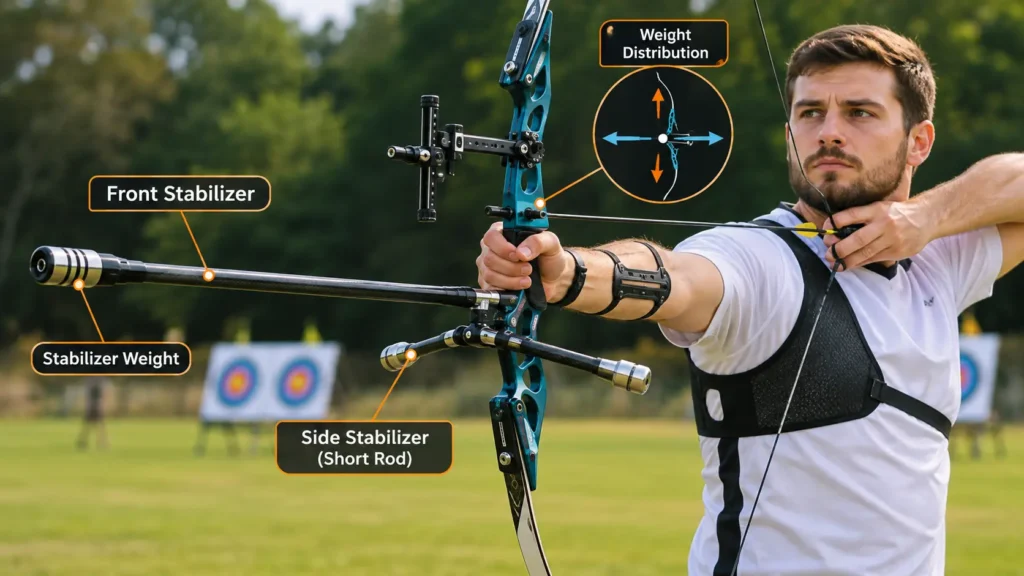
The Subtle Details That Shape Balance and Control in Modern Archery
Modern archery is shaped by a combination of technique, concentration and equipment. While an archer’s posture, draw cycle and release remain central to every shot, the way a bow is configured can also influence the overall shooting experience. Small differences in weight distribution, component positioning and equipment design may change how a bow feels during aiming and follow-through.
These details become particularly noticeable in target archery, where consistency is developed through repeated practice. A bow must feel manageable throughout the shooting sequence, from raising the equipment to completing the release. This is one reason the Archery Bow Stabilizer has become an important part of many modern equipment configurations.
Stabilizing equipment is not simply about adding more weight. Front bars, shorter side components, mounting brackets and adjustable weights each influence the way mass is distributed around the bow. Understanding these relationships provides a more interesting perspective on how archers develop equipment setups that complement their individual shooting preferences.
The Connection Between Equipment and the Archer’s Shooting Experience
Every archer develops a personal relationship with their equipment. Some prefer a relatively lightweight bow that feels easy to handle, while others favour a more developed setup with additional components. Neither preference is automatically better. Physical strength, shooting experience, bow type and personal comfort all influence equipment choices.
The experience of holding a bow at full draw is particularly important. During this stage, the archer must maintain posture, manage natural body movement and keep the bow aligned with the intended target. Even small differences in equipment balance can influence how the bow feels during this process.
This is where stabilizing accessories become relevant. Their position and mass can change the way a bow responds to movement. A carefully considered arrangement may provide a more suitable handling experience, while an unsuitable configuration can make the equipment feel unnecessarily heavy or awkward.
The objective is not to eliminate every movement. Human movement is a natural part of archery. Instead, the focus is on developing a comfortable and repeatable relationship between the archer and the bow.
Why Balance Is More Than the Total Weight of a Bow
Two bows can have a similar total weight but feel completely different when held. The reason is that total mass is only one part of equipment balance. The position of that mass also influences how the bow responds to movement and rotation.
For example, weight positioned farther away from the riser can have a different mechanical effect from the same amount of weight placed close to the mounting point. Similarly, adding a component to the side of a bow changes its balance in a different direction from adding one to the front.
These differences explain why Archery Stabilizers are available in different lengths and configurations. Their purpose is to give archers additional options for managing mass distribution and the handling characteristics of their equipment.
A balanced setup should also remain comfortable during longer practice sessions. An arrangement that feels manageable for a few shots may become tiring when repeated over an extended period. The archer’s strength, endurance and shooting routine should therefore remain part of the decision.
How Different Stabilizer Positions Influence Bow Configuration
Modern target bows can use several stabilizer positions. A front bar, side-mounted components and rear-facing bars provide different ways to distribute weight around the riser. Each position contributes differently to the overall arrangement.
The Role of Front Stabilizers
A front stabilizer extends forward from the riser and may carry additional weights near its outer end. Its position changes the distribution of mass toward the front of the bow and influences resistance to certain rotational movements.
The length of the bar and the amount of attached weight both matter. A longer bar changes the distance between the mounting point and the end mass, while a shorter bar creates a more compact arrangement. Neither configuration is universally suitable for every archer.
Why Side Rods Add Another Dimension
An Archery Side Stabilizer provides another option for adjusting the balance of a bow. It is generally mounted through a compatible bracket or V-bar, allowing the archer to position additional mass away from the side of the riser.
Accessories such as sights and other attachments can influence how weight is distributed across a bow. Side rods offer another adjustment position when an archer wants to modify the overall feel of the equipment.
The angle of a side rod also matters. A different mounting angle changes the position of its end weight, which can alter the way the bow feels when held. This is why mounting hardware and adjustment options are relevant when comparing different stabilizer arrangements.
The Place of Rear Stabilizers
An Archery Rear Stabilizer is positioned behind or angled away from the riser through compatible mounting hardware. It can form part of a multi-component setup designed to distribute weight in several directions.
Rear-facing arrangements are not simply about making the bow heavier. Their position changes the relationship between the riser and the additional mass. The final effect depends on the rod length, mounting angle and weight configuration.
For archers interested in a compact equipment arrangement, shorter stabilizing components can offer another way to explore these balance characteristics without relying entirely on long extensions.
Why Shorter Components Have a Place in Modern Equipment Design
Equipment design is not always about making components longer or adding more accessories. In many situations, a shorter component can provide a practical alternative when an archer wants a more compact arrangement.
Short stabilizer bars can be used in compatible side or rear mounting positions. Their dimensions influence where additional mass sits relative to the bow, while their construction and weight determine how they contribute to the complete setup.
A shorter bar may also suit archers who prefer a less extended equipment arrangement. However, its usefulness depends on the intended mounting position and the rest of the stabilizer configuration. A short component should not automatically be considered a replacement for a longer front stabilizer because the two positions can serve different purposes.
When comparing Stabilizers for Archery, it is helpful to look beyond appearance. Rod length, mounting compatibility, construction, weight options and the intended shooting discipline all deserve consideration.
The Importance of Weight Distribution and Equipment Feel
Archery Stabilizer Weights allow archers to adjust the amount of mass attached to different parts of a stabilizer system. Depending on the design, weights may be fitted to the end of a front bar, side rod or another compatible component.
Moving weight farther from the riser changes the mechanical response of the setup. However, adding more weight also increases the physical demands of holding and controlling the bow. This creates a balance between the desired equipment feel and the archer’s ability to manage the complete arrangement.
Gradual adjustments are generally easier to evaluate than changing several components at once. An archer can observe how the current configuration feels, make a small adjustment and assess the result during practice.
Changing multiple weights and mounting positions simultaneously makes it more difficult to understand which adjustment influenced the handling experience. A consistent approach provides clearer feedback and makes equipment comparisons more meaningful.
How Equipment Configurations Differ in Practice
Different stabilizer arrangements offer different adjustment possibilities. The following comparison highlights their general characteristics rather than suggesting that one configuration is automatically better than another.
| Equipment Configuration | Position | General Role | Main Consideration |
|---|---|---|---|
| Front Stabilizer | Forward from the riser | Influences forward weight distribution | Length and end weight |
| Short Side Stabilizer | Beside the riser | Provides lateral balance adjustment | Mounting angle and compatibility |
| Rear Stabilizer | Behind or angled away from the riser | Provides another weight distribution position | Position and overall bow handling |
| Multi-Rod Configuration | Front and side positions | Combines different stabilizing positions | Total weight and adjustment complexity |
| Compact Configuration | Shorter mounting positions | Provides a less extended arrangement | Intended use and balance preference |
The comparison demonstrates that equipment selection is not simply a matter of choosing the longest available rod. A compact arrangement may suit one archer, while another may prefer several adjustment positions. The important factor is how the complete setup works with the archer’s technique and physical requirements. For archers comparing a suitable Archery Bow Stabilizer, component length, mounting position and compatibility should be considered alongside the balance of the complete bow.
What Research Reveals About Balance and Bow Movement
Research in archery biomechanics provides useful insight into the relationship between body movement and bow stability. Although stabilizer equipment can influence how mass is distributed around the bow, shooting performance also depends on how the archer controls posture and movement throughout the aiming process.
A study by Sarro, Viana and de Barros, published in the European Journal of Sport Science in 2021, investigated the relationship between bow stability and postural control in recurve archery. The researchers studied eight archers who shot six arrows at a target positioned 13 metres away.
During the aiming phase, the researchers measured the movement of the bow and the archer’s centre of pressure. They found that three movement measures were higher in the lowest-scoring shot than in the highest-scoring shot: centre-of-pressure displacement across the target, centre-of-pressure trajectory length and bow trajectory length.
The study highlights the connection between the archer’s body movement and bow movement. It does not establish that a particular stabilizer design or weight configuration automatically improves accuracy. Instead, it provides evidence that body balance and bow stability are relevant factors when examining the shooting process.
Research-Based Graphical Chart: Body Balance and Bow Stability
The chart below presents the direction of the differences reported in the study. It compares movement measures associated with the highest-scoring and lowest-scoring shots. The visual bars are qualitative illustrations, not numerical measurements or percentages.
Lowest-scoring shot
Centre-of-pressure displacement
Higher movement: ██████████
Centre-of-pressure trajectory length
Higher movement: ██████████
Bow trajectory length
Higher movement: ██████████
Highest-scoring shot
Centre-of-pressure displacement
Lower movement: ███
Centre-of-pressure trajectory length
Lower movement: ███
Bow trajectory length
Lower movement: ███
Research comparison table:
| Measured Variable | Lowest-Scoring Shot | Highest-Scoring Shot |
|---|---|---|
| Centre-of-pressure displacement across target | Higher | Lower |
| Centre-of-pressure trajectory length | Higher | Lower |
| Bow trajectory length | Higher | Lower |
How to interpret the chart: The longer bars represent the direction of the higher movement measurements reported for the lowest-scoring shot. The shorter bars represent the lower measurements reported for the highest-scoring shot. They are illustrative, not proportional to actual measurement values. The study did not report a percentage improvement caused by using a stabilizer.
Why Consistency Matters More Than Equipment Complexity
A sophisticated equipment arrangement does not automatically create a consistent shooting experience. The archer still needs to develop a repeatable sequence involving posture, draw, aiming, release and follow-through.
A stabilizer setup should complement that sequence rather than introduce unnecessary physical demands. If the bow feels excessively heavy or uncomfortable, the archer may find it harder to maintain the same position throughout a longer practice session.
This is why equipment adjustments should be considered alongside physical comfort and technique. A configuration that feels suitable during a short test should also be evaluated during normal training conditions.
Some archers prefer a simple arrangement with fewer components. Others appreciate the additional adjustment possibilities offered by a more developed Archery Stabilizer Set. Both approaches can be appropriate when the equipment is compatible and the archer can manage it comfortably.
Materials, Construction and the Details Behind Equipment Design
Stabilizer construction can influence the practical experience of using archery equipment. Materials, rod stiffness, attachment quality and weight compatibility are all relevant when comparing different components.
Carbon and composite constructions are commonly found in stabilizing equipment. Their characteristics can vary according to the design and manufacturing process. Rather than assuming that a particular material is always superior, archers should consider the intended use and manufacturer specifications.
Mounting hardware deserves similar attention. A compatible connection helps ensure that the component can be attached correctly to the bow. Thread specifications, attachment angles and the design of the mounting bracket should be checked before selecting additional equipment.
These details may seem relatively small, but they influence whether a stabilizer arrangement can be configured as intended. A well-matched combination of components is more useful than an assortment of accessories that do not work together properly.
American and British Terminology in Archery Equipment
Archery equipment searches often use different spellings depending on the country. American English commonly uses Archery Stabilizer and Archery Stabilizers, while British English uses Archery Stabiliser and Archery Stabilisers.
Both versions describe the same general equipment category. This distinction is useful when researching international archery retailers, manufacturers and equipment discussions.
Searches such as Stabilizers Archery and Stabilizer Archery may also appear in different keyword variations. These phrases can refer to individual stabilizer bars, complete arrangements or the broader equipment category.
Understanding the terminology helps archers compare relevant components without confusing a single stabilizer bar with a complete multi-component setup.
When a More Flexible Stabilizer Arrangement Makes Sense
Some archers eventually look beyond a simple front-bar arrangement because they want additional options for adjusting weight distribution. A compatible mounting system can provide positions for shorter side components, rear-facing bars and additional weights.
These options can be useful when the archer wants to explore different balance characteristics without changing the entire bow. The important consideration is whether the components are compatible with the existing riser and whether the resulting configuration remains comfortable.
When comparing an Archery Bow Stabilizer or a more complete arrangement, it is worth considering the available bar lengths, mounting options, weight compatibility and construction. A shorter component may be relevant to an archer looking for a compact side or rear configuration, while a multi-rod arrangement provides additional adjustment positions.
However, more components also mean additional weight and more decisions about positioning. The best arrangement is not necessarily the most complicated one. It is the one that fits the archer’s equipment and shooting preferences.
The Continuing Relationship Between Technology and Technique
Archery equipment continues to develop, offering new materials, mounting designs and adjustment possibilities. Yet the central relationship between the archer and the bow remains the same. Equipment can influence balance and handling, but consistent shooting still requires practice, physical control and a repeatable technique.
Modern stabilizing accessories provide more ways to personalise a bow. Front bars, side rods, rear components and adjustable weights each contribute different options. Understanding these differences helps archers make decisions based on their actual requirements rather than following equipment trends without considering their own needs.
The same principle applies to every part of an archery setup. Compatibility, comfort and practical performance should remain more important than appearance or the number of accessories attached to the bow.
Final Thoughts
The details behind a modern archery setup often become most noticeable when an archer begins paying attention to balance, movement and equipment feel. Stabilizing components provide different ways to distribute mass around the bow, while their length and position influence how the complete arrangement behaves.
Whether an archer prefers a simple front stabilizer or a more developed combination of side and rear components, the objective remains to find a comfortable setup that supports a repeatable shooting process. Understanding the role of an Archery Bow Stabilizer is therefore about more than equipment selection. It is about recognising how design, balance and technique work together in modern archery.