

Why the Arrow Rest Deserves More Attention
In archery, accuracy is influenced by several equipment components working together. The bow, arrows, sight, release, and other accessories all contribute to the shooting experience. Among these components, the arrow rest may appear relatively small, but its role is important. It provides a contact point for the arrow before and during the shot, helping maintain a consistent starting position as the archer prepares to release.
An arrow rest is designed to support an arrow on the bow while allowing it to move forward when the string is released. Its design can influence how the arrow is held, how much contact occurs during the shot, and how the equipment behaves throughout repeated shooting sessions.
Different bows and shooting styles can require different arrow rest designs. A traditional bow, recurve bow, and compound bow may use different support arrangements depending on their construction and intended application. This is why choosing an arrow rest is not simply about selecting an accessory that fits visually. Its design and compatibility with the bow are equally important.
The Different Designs Behind Modern Arrow Rests
Arrow rests are available in several designs, each offering a different approach to supporting the arrow. Understanding these designs makes it easier to recognize why archers choose particular systems for different types of equipment and shooting activities.
Full-Containment Arrow Rests
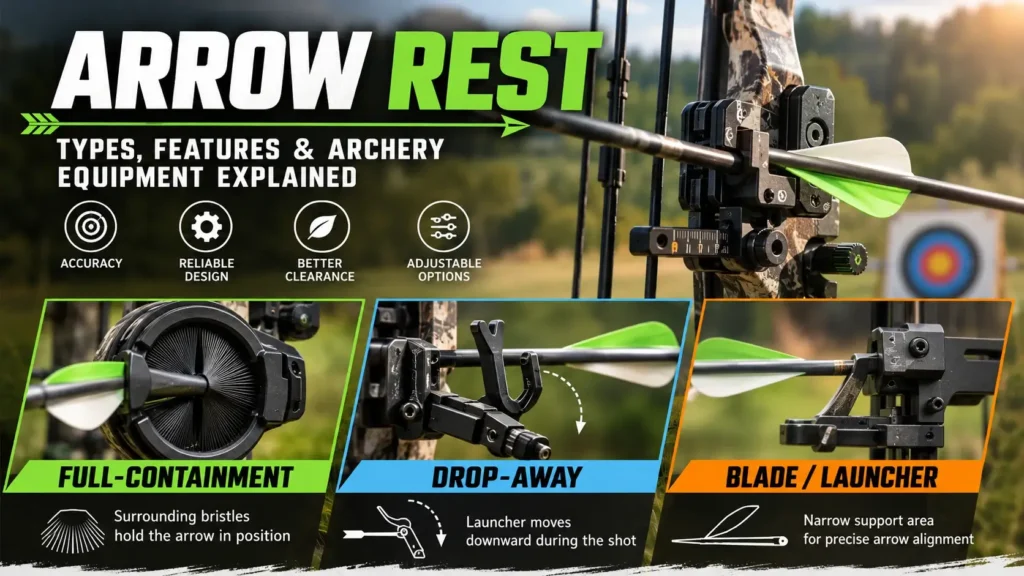
Full-containment arrow rests are designed to hold the arrow within a supporting structure. One familiar example is the Whisker Biscuit style, which uses surrounding bristles to keep the arrow in position. The arrow passes through these bristles when released.
This arrangement provides continuous arrow support before the shot. It can be useful in situations where keeping the arrow securely positioned is an important consideration, including certain hunting and recreational applications.
Drop-Away Arrow Rests
Drop-away arrow rests use a moving support mechanism. The launcher holds the arrow in position before release and then moves downward as the arrow travels forward. This movement is intended to reduce contact between the arrow and the rest during its passage.
Because these systems include moving components, their design and adjustment requirements can differ from simpler arrow rests. Archers considering a drop-away system should pay attention to its mechanism, compatibility, and overall construction.
Blade and Launcher Arrow Rests
Blade and launcher-style arrow rests support the arrow using a relatively small contact area. Depending on the design, the arrow sits on a blade or launcher arm rather than being surrounded by bristles or held by a larger containment structure.
These designs are commonly associated with target and competition archery, where adjustment and positioning are important equipment considerations. The blade or launcher provides the arrow’s support point, making its alignment and configuration relevant to the overall setup.
Some modern systems also include adjustment features that allow archers to make controlled changes to the launcher’s position. These features can be useful when equipment needs to be configured according to the bow and the archer’s requirements.
Arrow Rest Comparison: Understanding the Main Differences
Although different arrow rests perform the same basic function of supporting an arrow, their construction and operating methods can vary considerably. Comparing their main characteristics provides a clearer understanding of how each design approaches arrow support.
| Comparison Factor | Full-Containment | Drop-Away | Blade/Launcher |
|---|---|---|---|
| Arrow Support | Surrounding bristles or containment structure | Launcher supports the arrow before release | Blade or launcher arm supports the arrow |
| Arrow Retention | Designed to keep the arrow within the rest | Depends on the launcher and rest design | Depends on the support and launcher configuration |
| Fletching Contact | Fletching passes through surrounding bristles | Designed to move away during the shot | Depends on blade position and arrow clearance |
| Moving Mechanism | Generally uses a fixed containment structure | Uses a moving launcher mechanism | Usually uses a fixed blade or launcher arrangement |
| Adjustment Considerations | Depends on the specific model | Includes launcher and mechanism considerations | Includes blade position and launcher alignment |
| Common Shooting Context | Hunting and recreational archery | Compound bow applications | Target and competition archery |
| Main Design Consideration | Arrow containment and support | Launcher movement and clearance | Support position and adjustment |
No single arrow rest design is automatically the right choice for every archer. The most suitable option depends on bow compatibility, shooting requirements, personal preferences, and the characteristics of the equipment being used. Archers interested in a micro-adjustable blade-style AAE Freakshow Arrow Rest can explore its product features and available hand orientations.
Arrow Support and Fletching Clearance
One of the main responsibilities of an arrow rest is to provide a suitable support point for the arrow. Before release, the arrow needs to remain in a consistent position so that the archer can prepare and execute the shot. The rest therefore forms an important connection between the arrow and the bow.
Another consideration is fletching clearance. Fletchings are the vanes or feathers attached near the rear of an arrow. As the arrow moves forward, these components pass through the area occupied by the arrow rest. The rest’s design and positioning can influence whether the fletchings make contact with surrounding components.
Different arrow rest designs address this consideration in different ways. Full-containment systems use bristles, drop-away systems move the launcher out of the arrow’s path, and blade-style systems provide a narrower support arrangement.
Archers should consider arrow diameter, fletching configuration, rest design, and bow compatibility when evaluating clearance. These factors are more useful than assuming that every arrow rest will work equally well with every arrow configuration.
Why Adjustability Matters in Modern Archery Equipment
Modern archery equipment often includes adjustment features that allow individual components to be positioned according to the requirements of a particular bow. Arrow rests are no exception. Depending on the model, an archer may be able to adjust the launcher position, alignment, or other aspects of the support system.
These adjustments can be especially relevant in target archery, where equipment configuration is an important part of the overall shooting process. A rest with clearly defined adjustment points can make it easier to understand how its position changes and maintain a consistent equipment configuration.
Micro-adjustment features offer more controlled positioning than systems that rely entirely on broad manual movement. However, the usefulness of these features depends on the rest’s construction and the archer’s actual requirements. More adjustment options do not automatically make a product suitable for every bow or shooting style.
Locking mechanisms and reference markings can also contribute to the adjustment experience. They help provide visible positioning information and support controlled changes during equipment configuration.
The Role of Arrow Rest Design in Different Archery Activities
Archery includes several disciplines, and equipment requirements can vary depending on the activity. An arrow rest used for competition shooting may have different priorities from one selected for hunting or recreational use.
Target Archery
Target archery places considerable attention on equipment consistency and repeatable shooting conditions. Archers often evaluate individual components according to their construction, adjustment features, and compatibility with the rest of the bow setup.
Blade and launcher-style arrow rests are relevant in this environment because their support arrangement allows attention to be given to launcher positioning and alignment.
Bow Hunting
Bow hunting introduces different equipment considerations. An archer may place greater importance on keeping the arrow positioned securely while moving or preparing for a shot. This helps explain the popularity of certain full-containment designs in hunting applications.
Drop-away arrow rests are also used in compound bow setups. Their moving launcher design provides a different approach to arrow support and clearance.
3D and Recreational Archery
Three-dimensional and recreational archery bring together a range of shooting environments and equipment preferences. Some archers use equipment similar to target setups, while others prefer arrangements associated with hunting or general recreational shooting.
In these activities, the arrow rest should be evaluated as part of the complete bow configuration. Its design, adjustment options, and compatibility can all influence whether it is appropriate for the intended application.
Precision Engineering and the AAE Freakshow Arrow Rest
For archers interested in adjustable blade and launcher systems, the AAE Freakshow Arrow Rest is one product worth considering. Its design includes several features focused on launcher positioning and adjustment, making it relevant to archers comparing precision-oriented arrow rest systems.
The Freakshow includes a micro-adjustable design and a hex alignment launcher blade. These features provide adjustment options for configuring the launcher and its position.
Another feature is its rotating launcher arm. This component forms part of the rest’s launcher arrangement and contributes to the way the arrow is supported. The product also includes lock-down adjustment screws, which are designed to secure adjustments after positioning.
Reference marks are another practical detail. They provide visible points that can help users identify adjustment positions when configuring the rest. The product is also available in right-hand and left-hand options, allowing archers to select the appropriate version for their shooting orientation.
These features make the AAE Freakshow a relevant option for archers looking for a micro-adjustable blade-style arrow rest. As with any archery accessory, buyers should confirm that the selected version is compatible with their bow and intended equipment configuration before purchasing.
Material, Construction, and Long-Term Equipment Considerations
The construction of an arrow rest is another factor worth considering. An arrow rest is part of a bow’s working equipment, so its components need to suit the demands of regular use. The design may include a mounting structure, launcher, adjustment screws, and other parts depending on the model.
Different designs have different maintenance considerations. A full-containment rest may require attention to the condition of its bristles, while a drop-away system includes moving components that should be checked as part of routine equipment inspection. Blade and launcher rests require attention to their support components, mounting, and adjustment hardware.
Regular inspection can help identify loose fasteners, visible wear, or changes in component positioning. Archers should follow the manufacturer’s instructions for installation, adjustment, and maintenance rather than making changes without understanding how the system works.
Construction should also be considered alongside the product’s intended application. A design that suits one shooting discipline may not provide the features another archer needs.
Compatibility Is More Important Than Appearance
An arrow rest may look suitable for a particular bow, but appearance alone does not establish compatibility. Before choosing a product, archers should consider the bow type, mounting arrangement, hand orientation, and intended arrow configuration.
Compound bows, recurve bows, and traditional bows can have different equipment requirements. A rest designed for one type of bow should not automatically be assumed to fit another. Mounting position and the available adjustment range are also important considerations.
Hand orientation is another detail buyers should check. Some products are available in separate right-hand and left-hand versions. Selecting the correct option is necessary to ensure that the product matches the archer’s setup.
It is also useful to consider the arrows being used. Arrow diameter, fletching type, and the rest’s support design should be evaluated together. Checking the manufacturer’s product information before purchasing can help avoid choosing an incompatible component.
Why the Smallest Components Can Have a Meaningful Role
Archery equipment is made up of several components, and each has a particular function within the complete setup. While larger items such as bows and sights often receive more attention, smaller accessories can also influence how the equipment is configured and used.
The arrow rest is a clear example. It provides the arrow’s support point and forms part of the process that takes place immediately before and during release. Its design determines how the arrow is held and how the support system interacts with the arrow as it moves forward.
Choosing an arrow rest therefore involves more than selecting a familiar product category. Archers need to consider the type of bow, shooting discipline, support arrangement, adjustment features, and compatibility with their arrows.
Frequently Asked Questions
What is an arrow rest?
An arrow rest is a component mounted on a bow that supports the arrow before it is released. It provides a designated position for the arrow and forms part of the bow’s overall shooting setup.
What are the main types of arrow rests?
Common arrow rest designs include full-containment rests, drop-away rests, and blade or launcher-style rests. Each uses a different method to support the arrow and has its own design characteristics.
What is a compound bow arrow rest?
A compound bow arrow rest is an arrow support system designed for use with a compound bow. Available designs include full-containment, drop-away, and blade or launcher-style systems. The appropriate option depends on the bow and the archer’s requirements.
What is a blade arrow rest?
A blade arrow rest uses a narrow blade or launcher surface to support the arrow. It is commonly associated with target and competition archery setups, where launcher positioning and adjustment can be important considerations.
Are drop-away arrow rests different from full-containment rests?
Yes. A full-containment rest uses a surrounding structure, often bristles, to hold the arrow in position. A drop-away rest uses a launcher that moves downward as the arrow is released. Their support methods and mechanical designs are different.
Can one arrow rest fit every bow?
No. Arrow rest compatibility depends on factors such as bow type, mounting arrangement, hand orientation, and arrow configuration. Buyers should check the manufacturer’s compatibility information before selecting a product.
What makes an adjustable arrow rest useful?
An adjustable arrow rest provides options for changing the position or alignment of its launcher. Depending on the design, features such as micro-adjustments, locking screws, and reference marks can make equipment configuration more controlled.
What should I check before buying an arrow rest?
Consider your bow type, shooting activity, mounting requirements, hand orientation, arrow configuration, and the rest’s adjustment features. Reviewing the manufacturer’s specifications is also important before making a purchase.
Final Thoughts
An arrow rest may be a small component, but its function is an important part of a bow’s overall equipment arrangement. From full-containment systems to drop-away and blade-style designs, different arrow rests offer different approaches to supporting an arrow.
The right choice depends on the archer’s equipment, shooting discipline, and preferred design features. Understanding these differences makes it easier to compare available options and identify a product that meets the requirements of a particular setup.
For archers exploring adjustable blade-style systems, the AAE Freakshow Arrow Rest offers features such as micro-adjustment, a hex alignment launcher blade, a rotating launcher arm, lock-down adjustment screws, and reference marks. Evaluating these features alongside bow compatibility can help buyers make a more informed equipment decision.