

When Archery Equipment Has Somewhere to Go
Archery is often associated with the shooting range, outdoor competitions, and hunting locations. However, a significant part of owning archery equipment happens away from the shooting line. Bows, arrows, protective accessories, and other essential items regularly move between homes, vehicles, clubs, and outdoor locations. How this equipment is packed and transported can make a noticeable difference to the overall experience.
A bow case is usually one of the first things an archer considers when organising equipment. It provides a dedicated place for the bow, helps protect sensitive components, and keeps related accessories together. But the requirements are not always the same. Someone travelling a short distance to a local range may prefer a lightweight carrying arrangement, while someone attending competitions or travelling with several pieces of equipment may need a more organised transportation setup.
The type of bow also influences these decisions. Compound bows have cams, cables, and other components that need appropriate clearance. Recurve bows can have different storage requirements, particularly when they are designed to be taken down for transportation. Alongside the case itself, the way an archer carries the equipment can affect convenience during longer journeys.
Modern archery transportation is therefore about more than finding somewhere to store a bow. It involves balancing protection, organisation, carrying comfort, and the practical demands of travelling with equipment.
The Part of Archery That Begins After the Shooting Session
When a shooting session finishes, equipment still needs attention. The bow must be put away properly, arrows need to be secured, and smaller accessories should be organised before everything is transported home.
This routine may seem straightforward, but archery equipment contains components that can be affected by unnecessary pressure, impact, and movement. Compound bow cams, limbs, sights, strings, and cables should not be allowed to press against unrelated objects during transportation. Recurve bow limbs and risers also need suitable storage arrangements, particularly when the equipment is disassembled.
A suitable archery case helps create a more controlled storage environment. Internal padding, straps, dividers, and separate accessory compartments can reduce unnecessary movement. These features are useful because a case should do more than simply close around the equipment; it should hold the contents in an organised position.
There is also a practical difference between storing a bow at home and moving it regularly. Equipment that remains in one location may not need the same carrying features as a setup that travels several times a week. The best arrangement depends on the archer’s routine, the equipment being carried, and the conditions it will encounter.
Different Bows Bring Different Storage Requirements
Archery equipment is not made to one universal size or shape. A case that works well for one bow may be unsuitable for another. This is especially important when comparing compound bows with recurve bows.
Compound Bows and Their Additional Components
A compound bow has a mechanical structure that includes limbs, cams, axles, cables, and a string system. Depending on the model, it may also have a sight, arrow rest, stabiliser, quiver, and other accessories attached.
A compound bow case needs enough internal space to accommodate the actual configuration of the bow. The axle-to-axle measurement, overall width, cam clearance, and attached accessories can all affect compatibility.
Some archers remove selected accessories before placing the bow inside the case, while others prefer storage arrangements that accommodate more of the assembled setup. Either approach requires checking the case’s internal dimensions and securing options. A case should never need to be forced closed around a bow or put unnecessary pressure on its components.
Recurve Bows and Takedown Equipment
A recurve bow can have a different storage arrangement, particularly when it uses a takedown design. In these setups, the limbs can be separated from the riser, allowing the equipment to be stored in a more compact configuration.
A recurve bow case may therefore include individual sections for the riser, limbs, string, and smaller accessories. Other designs accommodate a fully assembled bow. The correct option depends on the bow’s dimensions and the owner’s preferred way of transporting it.
These differences explain why a case for a bow should be selected according to the actual equipment rather than its general appearance. A suitable fit is more important than simply choosing a case labelled for a particular category.
Hard Cases, Soft Cases and the Everyday Decisions Archers Make
One of the most familiar decisions in archery equipment storage is choosing between a hard bow case and a soft bow case. Both have a place, but they offer different combinations of protection, weight, and convenience.
When a Hard Case Makes Sense
A hard case generally uses a rigid outer shell designed to maintain its shape during transportation. Depending on the construction, it can provide a stronger barrier against external pressure and impacts than a fabric-only design.
This can be useful when a bow travels in a crowded vehicle, shares luggage space with other equipment, or is transported over longer distances. Some hard cases include shaped foam interiors, internal tie-downs, reinforced hinges, and lockable latches.
A compound bow hard case should still be checked carefully for internal clearance. A rigid shell does not automatically guarantee a suitable fit. If the case is too narrow or the internal supports are positioned incorrectly, sensitive components may still be exposed to unwanted pressure.
The main trade-off is that hard cases can be bulky and relatively heavy. Moving one over a long distance may become inconvenient, especially when the archer is also carrying personal luggage or additional equipment.
The Convenience of a Soft Bow Case
A soft bow case usually has a fabric exterior with an internal padded structure. It is often easier to carry, store, and fit into a vehicle than a large rigid case.
For regular trips to an archery club or shooting range, a well-padded soft case can provide a practical arrangement. Many designs include shoulder straps, handles, accessory pockets, and internal securing straps.
However, the level of protection depends on the quality and thickness of the padding and the way the equipment is secured. A soft case generally offers less resistance to crushing pressure than a rigid design, so it should not automatically be treated as suitable for every type of travel.
Some archers prefer soft storage because it is easier to handle during everyday use. Others prefer the additional structure of a hard case. Neither option is universally better; the transportation conditions should determine the choice.
What Happens When the Case Becomes Difficult to Carry?
Protection is only one part of equipment transportation. Once a bow has been packed, the next question is how to move the loaded case comfortably.
A case with a conventional handle may be perfectly practical for a short walk from a vehicle to a shooting line. The situation changes when the distance becomes longer or when several pieces of equipment need to be carried at once.
Carrying a heavy case in one hand for an extended period can become tiring. A shoulder strap offers another option, while a backpack-style arrangement can distribute some of the load across the shoulders and back. This can be particularly useful when moving through large venues or walking between different areas of an outdoor location.
Wheels provide another approach. A wheeled transportation arrangement allows compatible equipment to be moved along suitable surfaces without continuously supporting its full weight. This can be useful at events, exhibition venues, and locations with longer paved routes.
The important point is that carrying convenience and case protection are two different requirements. A case protects the equipment, while an additional carrying arrangement changes how the loaded case is transported.
The Different Ways Archers Move Their Equipment
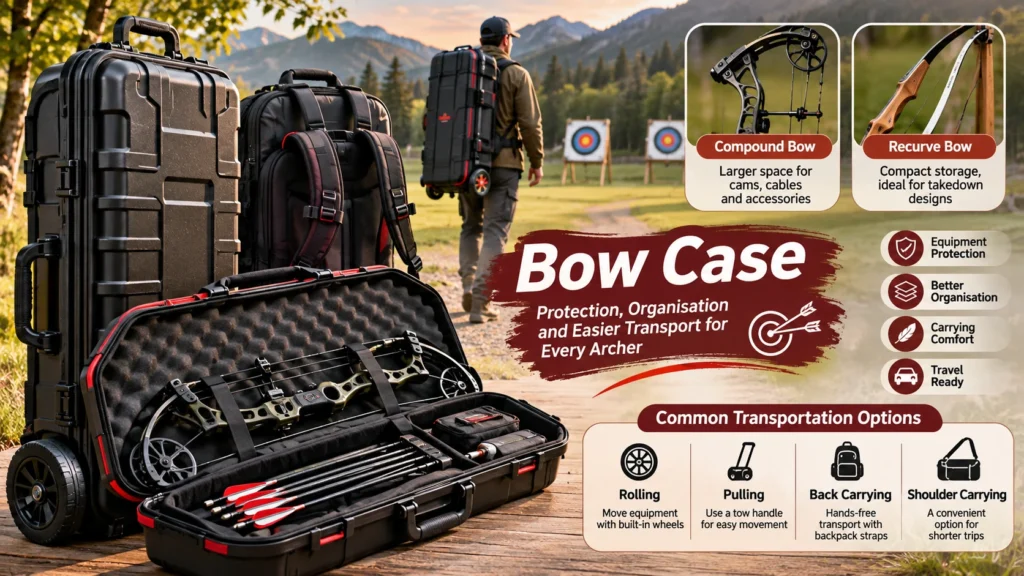
Archery equipment comes with several transportation features. These include rigid outer construction, wheels, tow handles, backpack straps, and separate accessory storage.
Some combination designs bring several of these features together. A rigid outer case may provide structure, wheels may support rolling transportation, and an included soft case may offer backpack straps or a shoulder strap.
The following comparison identifies different transportation features and explains their practical purpose. It is a feature comparison, not a measurement of market share, product quality, or the percentage of all bow cases offering these features.
Transportation Features and Their Practical Uses
| Transportation Feature | How It Works | Practical Purpose |
|---|---|---|
| Rigid outer protection | Uses a structured exterior | Provides a protective barrier around stored equipment |
| Built-in wheels | Allows the case to roll | Reduces the need to carry the full load on suitable surfaces |
| Tow handle | Provides a grip for pulling | Makes it easier to move a compatible wheeled case |
| Backpack straps | Allow the case to be carried on the back | Provides a hands-free carrying option |
| Shoulder strap | Supports carrying over one shoulder | Offers an alternative to holding the case by its handle |
| Accessory storage | Uses separate pockets or compartments | Keeps smaller archery equipment organised |
Visual Chart: Four Common Transportation Methods
| Transportation Method | Associated Feature | Visual Indicator |
|---|---|---|
| Rolling | Built-in wheels | ■■ Present |
| Pulling | Tow handle | ■■ Present |
| Back carrying | Backpack straps | ■■ Present |
| Shoulder carrying | Shoulder strap | ■■ Present |
What the chart shows: Archery equipment can be transported using several different methods. Rolling and pulling are useful on suitable surfaces, while backpack and shoulder carrying provide alternatives when walking or moving through areas where wheels are impractical.
Chart limitation: This is a qualitative comparison of transportation features, not a statistical survey or controlled performance test. Feature availability varies by case and carrying system.
Making Long-Distance Equipment Transport More Practical
The distance between a vehicle and an archery destination can sometimes be greater than expected. Competition venues, large outdoor ranges, and hunting locations may require equipment to be moved across different surfaces.
In these situations, a traditional carrying handle may not be the most convenient option. Backpack-style carrying can help when the route involves walking, while wheels can be useful on smooth paths and paved surfaces.
A combined carrying arrangement offers another possibility by allowing compatible equipment to be moved using more than one method. Rather than depending entirely on one handle or shoulder position, the archer can select an arrangement that suits the route and the weight being transported.
For archers who want more flexibility when transporting their equipment, a suitable bow case carrying arrangement can provide a back-carrying and wheel-assisted option for compatible cases. This type of setup can make moving equipment more flexible and provide an alternative to carrying the entire load by hand.
Compatibility is an important consideration. A carrying system should be used with the cases and attachment arrangements it is designed to support. It should not be treated as a replacement for the case’s protective structure or internal storage features.
Keeping Arrows and Accessories Organised During Travel
A bow is rarely the only item an archer takes to a shooting session. Arrows, quivers, stabilisers, release aids, sights, tools, and spare components may all be part of the equipment setup.
A bow and arrow case can make this routine easier when it includes suitable compartments for the items being transported. Separate storage helps prevent smaller accessories from moving around and coming into contact with sensitive bow components.
Arrows should be secured in an appropriate compartment or protective tube. They should not be left loose beside the bow, where movement could cause scratches or damage to other equipment. Sharp accessories should also be stored safely and separately where necessary.
For compound bow owners, it is particularly useful to consider the space required for sights, rests, quivers, and stabilisers. Some cases accommodate selected accessories while others require them to be removed before storage.
Organisation also makes it easier to check equipment before leaving home. When every item has a dedicated place, it becomes simpler to identify missing accessories and prepare for the next shooting session.
When Archery Equipment Travels by Car, Air or Public Transport
Different journeys create different transportation requirements. A case that works well for a short trip to a local range may not be the most practical choice for an international competition or a longer road journey.
For vehicle travel, equipment should be secured so that it does not move unnecessarily. Heavy luggage should not be placed on top of a soft case, and the bow should be positioned so that external objects do not press against its cams, limbs, or accessories.
Air travel requires additional planning. Archers should check the airline’s current sporting-equipment and baggage rules before travelling. A soft bow case should not automatically be assumed suitable for checked baggage. A rigid case designed for demanding transportation may be a more appropriate choice, depending on the airline’s requirements.
Public transport creates another set of practical considerations. A bulky hard case may be more difficult to manage in crowded areas, while a suitable soft case or backpack-style carrying arrangement may offer greater convenience. The actual choice depends on the size of the equipment, the distance, and the available storage space.
For outdoor journeys, surface conditions also matter. Wheels may work well on smooth paths but become less useful on mud, loose gravel, or uneven ground. A carrying option that works in one environment may not be equally convenient in another.
What Makes a Bow Case Suitable for Regular Use?
Choosing among the best bow cases involves more than looking at exterior appearance or the number of pockets. A suitable case should match the bow, provide appropriate protection, and work with the owner’s normal transportation routine.
Several details are worth checking before making a decision:
- Internal dimensions: Compare the available internal length, width, and depth with the bow’s actual measurements.
- Bow compatibility: Confirm whether the case is designed for a compound bow, recurve bow, or another equipment type.
- Internal padding: Check whether the padding protects the areas that need support.
- Securing straps: Look for suitable arrangements that help prevent the bow from shifting.
- Accessory storage: Consider whether arrows, stabilisers, and other accessories have appropriate compartments.
- Carrying options: Review handles, shoulder straps, backpack straps, wheels, or compatible carrying accessories.
- Overall weight: Consider the combined weight of the empty case and the packed equipment.
- Construction: Match the materials and protective structure to the conditions in which the case will be used.
These details are relevant whether someone is considering a traditional hard case bow, a soft fabric design, or a transportation system that works alongside an existing case.
Looking After the Case Between Shooting Sessions
Equipment care does not finish when the bow is packed away. The case itself should also be checked and maintained, especially when it is used regularly.
Fabric cases should be allowed to dry properly if they become damp. Dirt and dust can be removed according to the manufacturer’s cleaning instructions, while zippers and stitching should be checked for signs of wear.
For a hard case, inspect hinges, latches, handles, and wheels. These components experience regular use and can affect how securely the case closes or how easily it moves. Internal foam and securing straps should also be checked for damage or compression.
Carrying accessories deserve similar attention. Straps, buckles, attachment points, and wheels should be inspected before longer journeys. Any damaged component should be addressed before relying on the setup to transport valuable equipment.
After returning from an outdoor trip, it is sensible to check the bow and accessories before putting everything into long-term storage. Removing dirt and moisture and allowing equipment to dry can help maintain a more organised storage environment.
Final Thoughts: Archery Equipment Should Be Easy to Move and Protect
Owning archery equipment involves more than choosing a bow and preparing for the next shooting session. Storage, protection, organisation, and transportation all contribute to the overall experience.
A suitable bow case helps keep equipment together and provides protection appropriate to the journey. Hard cases, soft cases, and recurve-specific storage arrangements each serve different purposes. The right choice depends on the bow’s dimensions, the accessories being carried, and the conditions the equipment is likely to encounter.
Carrying convenience is another important part of the picture. Shoulder straps, backpack arrangements, wheels, and combined transportation systems provide different ways to move equipment between locations. They do not replace the protective role of the case, but they can make the process more manageable.
Ultimately, a well-planned transportation setup should protect the bow, keep accessories organised, and make every journey between the workshop, vehicle, and shooting range more convenient.