

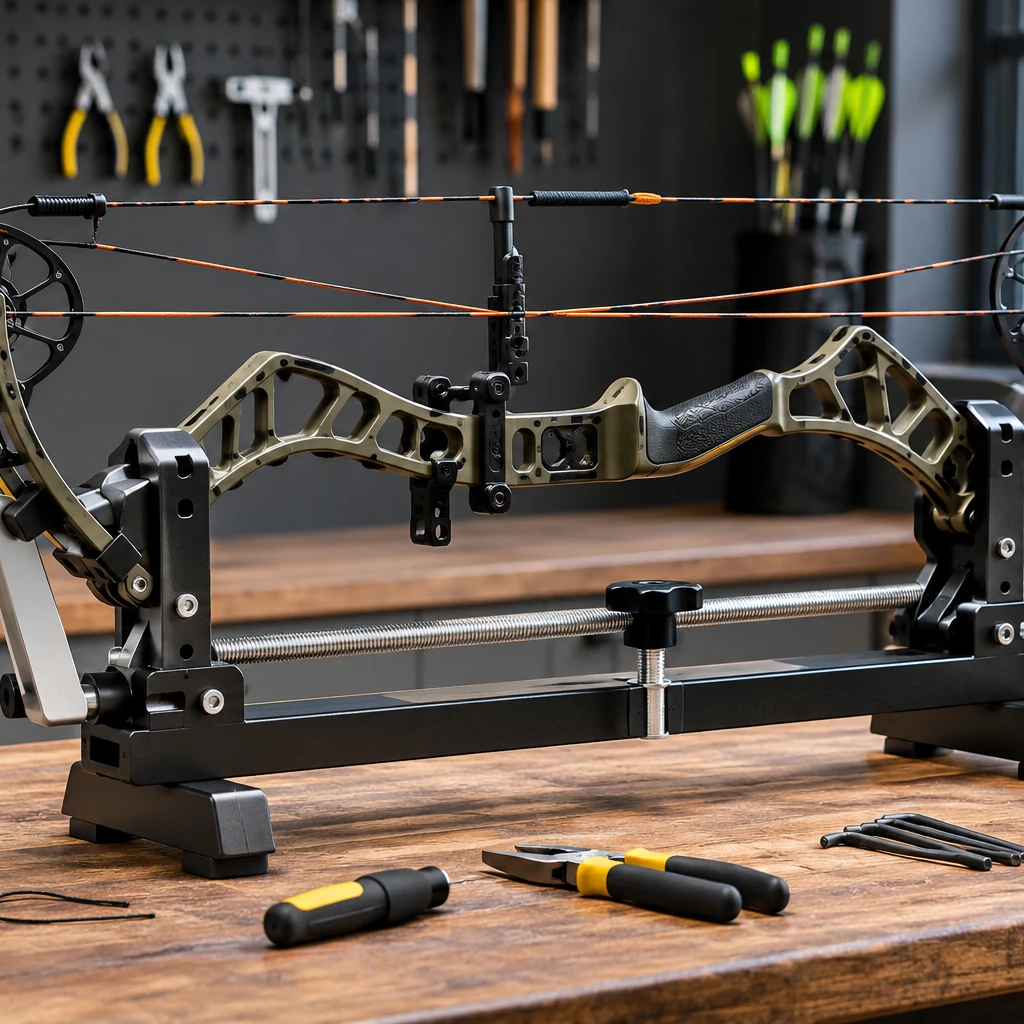
The Hidden Side of Compound Archery: Equipment, Maintenance and the Bow Press
Most conversations about compound archery focus on shooting technique, bow performance, accuracy, and equipment selection. Archers spend time adjusting their sights, testing arrows, improving their form, and finding a setup that feels comfortable. However, there is another side of the sport that receives less attention: the equipment maintenance that keeps a compound bow in working condition.
Behind every well-maintained compound bow is a combination of inspection, careful adjustments, and suitable workshop equipment. Strings and cables experience wear, components sometimes need attention, and certain maintenance procedures require specialised tools. One of the most important pieces of equipment in this process is a bow press.
Although it may not be used during everyday shooting sessions, a bow press plays an important role whenever approved string, cable, or other maintenance work is required. Its design, operating method, and compatibility with different bow models all matter. The growing availability of portable equipment has also introduced new possibilities for archers who maintain their equipment outside a traditional workshop.
Understanding this less visible part of archery provides a better picture of how compound bows are maintained and why choosing suitable equipment is about much more than convenience.
The Work That Happens Behind Every Compound Bow Setup
A compound bow is a mechanical system in which the limbs, cams, axles, string, and cables work together. Each component contributes to the way the bow operates, and the condition of one part can influence the performance of the overall setup.
Unlike some traditional bows, a compound bow keeps its string and cable system under considerable stored tension even when it is not being drawn. This is one reason why certain maintenance procedures cannot be approached casually. Replacing a string, working on cables, or making selected adjustments may require the limbs to be flexed in a controlled manner.
This is where an archery bow press becomes relevant. It provides a mechanical way to manage limb tension so that an experienced technician can carry out approved maintenance work. Depending on the bow design and manufacturer instructions, this may include string replacement, cable work, peep sight adjustments, serving repairs, and selected cam-related maintenance.
The press is not a replacement for technical knowledge. It is a specialised piece of equipment that allows particular tasks to be performed using an appropriate support system.
Why a Bow Press Has Become Part of Modern Compound Archery
Compound bow designs have changed considerably over the years. Manufacturers have introduced different limb configurations, cam systems, axle arrangements, and technologies intended to improve the shooting experience. These developments have also influenced the equipment required for servicing modern bows.
Older workshop equipment cannot automatically be considered suitable for newer compound bows. A pressing method that was acceptable for one design may be restricted on another. This is why bow manufacturers publish specific instructions about which bow presses can be used with their products.
For example, Hoyt’s official safety information identifies approved bow presses and warns against using unapproved equipment. The manufacturer explains that an unsuitable press can cause equipment failure, injury, and warranty issues.
This makes compatibility an essential part of compound archery maintenance. A bow press should be evaluated according to the exact bow model, not simply because its frame or attachments appear suitable.
When Equipment Maintenance Becomes Part of an Archer’s Routine
Archery equipment does not remain unchanged forever. Regular shooting, transportation, storage conditions, and normal component wear can all create reasons to inspect a bow. Strings and cables are particularly important because they are central to the operation of a compound bow.
An archer may notice worn serving, a peep sight that needs attention, or a string that requires replacement. These situations do not necessarily mean that something is seriously wrong with the bow. They are part of the maintenance considerations that come with owning and using precision equipment.
Some procedures can be handled through routine inspection, while others require specialised tools and professional experience. A suitable bow press may be needed when the work involves managing limb tension.
Common maintenance situations that may involve an approved press include:
- String replacement: Replacing worn or damaged bowstrings.
- Cable maintenance: Replacing or servicing cables.
- Peep sight work: Installing or adjusting a peep sight.
- Serving repairs: Repairing or replacing serving material.
- Cam adjustments: Carrying out selected cam timing adjustments.
- Technical servicing: Completing other manufacturer-approved procedures involving the string and cable system.
Not every modern compound bow requires a press for every adjustment. The owner’s manual should always be checked before deciding which procedure or equipment is appropriate.
The Different Designs Behind Bow Press Equipment
Bow presses have developed through different mechanical designs. Some are intended for permanent workshop installations, while others are designed to be transported or stored more easily. The way each system supports a bow is particularly important because pressure must be applied only through approved contact points.
Workshop and Limb-Tip Systems
Many modern compound bow maintenance systems use a rigid workshop frame with adjustable fingers or supports. In a suitable limb-tip design, the press contacts approved areas near the limb tips and applies controlled pressure according to its operating instructions.
These systems are commonly associated with professional archery workshops, where technicians may work on different compatible bow models. Adjustable components and model-specific adapters can be important when the equipment is designed to accommodate different limb configurations.
A traditional workshop press is not automatically universal, however. The bow manufacturer’s approval remains essential, even when the press has multiple adjustment options.
Portable Bow Press Designs
A portable bow press offers a different approach to equipment storage and transportation. Depending on the design, it may use cables, straps, adapters, or a compact mechanical arrangement to support an approved maintenance procedure.
For archers who travel between ranges, hunting locations, and events, portability can be an attractive feature. Equipment that is easier to transport may provide additional flexibility when suitable maintenance support is not immediately available.
However, portable designs are not automatically suitable for every compound bow. Some manufacturers restrict portable pressing systems or require particular adapters. A portable press should therefore be considered only after checking the exact bow model and its approved maintenance requirements.
Older Roller and Grip-Contact Designs
Older bow presses include designs that apply pressure through rollers positioned along the middle sections of the limbs. Other historical systems use contact arrangements around the grip area.
These designs are important when discussing the development of bow presses, but they should not be assumed suitable for modern compound bows. Some manufacturers specifically prohibit certain roller or grip-contact methods because of the way pressure is transferred through the bow.
The difference between older and newer equipment demonstrates why the appearance of a bow press is not enough to determine whether it is appropriate for a particular model.
Why Portability Matters Outside a Traditional Archery Workshop
Archers do not always spend their time around a permanent workshop. Hunting trips, competitions, outdoor events, and regular travel can take equipment far from the place where professional servicing is normally available.
In these situations, the practical value of portable archery equipment becomes easier to understand. A compact maintenance system may be simpler to store and transport than a large workshop installation. Depending on its design and approved applications, it can offer greater flexibility for people who regularly work with compatible equipment.
Consider an experienced archer who travels frequently and maintains several bows. Having access to suitable equipment may make certain approved maintenance tasks more convenient. The same can apply to a technician who attends events and needs to transport selected workshop tools.
For archers exploring portable maintenance equipment, a suitable bow press can be one option to investigate. However, convenience is only one part of the decision. The press must be appropriate for the bow, the operator must understand the instructions, and the working environment must provide suitable support. A portable design should never encourage someone to attempt a repair without the required experience.
Portable and Workshop Bow Presses: How Their Roles Differ
Portable and fixed workshop equipment serve different practical needs. Their value depends on the user’s working environment, maintenance frequency, storage requirements, and the compatibility rules of the bow manufacturer.
| Comparison Point | Portable Bow Press | Workshop Bow Press |
|---|---|---|
| Primary purpose | Transportable maintenance support for approved applications | Dedicated equipment for workshop maintenance |
| Storage | Often easier to store and transport, depending on design | Usually requires a permanent or dedicated space |
| Construction | May use compact mechanical, cable, or strap-based systems | Often uses a rigid frame and adjustable supports |
| Working location | Can offer flexibility when suitable support is available | Generally used in a workshop environment |
| Maintenance use | Depends on the specific model and approved applications | May support different workshop procedures with suitable adapters |
| Compatibility | Must be checked against the bow manufacturer’s instructions | Must also meet the bow manufacturer’s instructions |
Neither category is automatically better. A technician who services bows every day may prefer a dedicated workshop system, while an experienced archer who travels may value a suitable portable option. In both cases, manufacturer approval and correct operation are more important than convenience.
What Manufacturer Recommendations Reveal About Press Compatibility
One of the most interesting aspects of modern compound archery is that different manufacturers can have different requirements for pressing their bows. These requirements are not minor details. They influence which equipment can be used and which methods should be avoided.
Archery Insider’s comparison of manufacturer guidance highlights several examples. Mathews specifies limb-tip pressing and advises against portable bow presses on its bows. Elite also identifies limb-tip press requirements and does not recommend portable systems. Bear’s guidance focuses on approved pressing arrangements and restrictions against certain mid-limb roller and grip-only designs.
These examples demonstrate why the phrase bow press for compound bows covers more than one universal piece of equipment. A press suitable for one bow may not be appropriate for another, even when both belong to the same general equipment category.
Hoyt provides another example through its official approved-press information. Its published guidance identifies specific press systems and, in some cases, required adapters. This reinforces the importance of checking the manufacturer’s latest guidance rather than relying on general product descriptions.
The following comparison summarises the number of distinct press-design restriction categories explicitly mentioned in the manufacturer comparison discussed by Archery Insider. These figures represent only the categories mentioned in that source.
Bow Press Design Restrictions Mentioned in Manufacturer Guidance
| Manufacturer | Restriction Categories Mentioned | Visual Comparison |
|---|---|---|
| Mathews | 1 | █ |
| Elite | 1 | █ |
| Bear | 2 | ██ |
How to read the comparison: Each block represents one restriction category mentioned in the source.
Source: Archery Insider’s manufacturer comparison. Mathews: portable press restriction; Elite: portable press not recommended; Bear: mid-limb roller and grip-only press restrictions.
Note: These figures are not a safety score, failure rate, or complete industry-wide count. They reflect only the categories described in the cited comparison.
Equipment Quality and the Details That Matter
When people discuss bow presses, attention often goes straight to their size or operating mechanism. However, the overall construction and design details are equally important.
A press works with a bow that stores significant energy. Its frame, contact components, adjustment mechanism, and supporting parts must be suitable for the intended application. Poorly maintained or damaged equipment should never be used.
There are several practical details worth considering when evaluating bow presses:
- Construction: The frame and mechanical components should be designed for the intended maintenance work.
- Contact arrangement: The support points must match the approved pressing method for the bow.
- Adjustment system: The operating mechanism should allow controlled use according to the manufacturer’s instructions.
- Adapters: Some bow models require particular fingers, straps, or adapters to achieve an approved fit.
- Storage: Transport and storage arrangements can influence how practical the equipment is for regular use.
- Instructions: Clear manufacturer guidance is important for understanding the equipment’s intended limits.
These considerations apply whether someone is evaluating a portable bow press or a larger workshop installation. A well-built product is not necessarily compatible with every bow, so construction quality and manufacturer approval must be considered separately.
Why Safe Maintenance Requires More Than the Right Tool
Using a suitable bow press is only one part of responsible compound bow maintenance. The person operating it must also understand the bow’s construction and follow the correct procedure.
Manufacturers warn that incorrect pressing methods can cause equipment damage and personal injury. Hoyt, for example, specifically advises using only its approved presses and recommends that its bows be serviced by authorised retailers. Other manufacturers publish their own requirements, which may differ by model and limb design.
Before any maintenance work, the bow and press instructions should be reviewed. The equipment should be inspected for damage, and only the specified contact points and adapters should be used. Safety glasses and other recommended protective equipment should be worn where required.
It is also important not to improvise mounting arrangements or apply pressure beyond the manufacturer’s prescribed procedure. If the correct method is unclear, the safest decision is to stop and consult a qualified archery technician.
A bow press is a specialised tool, not a shortcut around professional knowledge. Correct equipment and correct operation must work together.
The Relationship Between a Bow Press and Other Workshop Tools
A bow press is sometimes discussed alongside other archery workshop equipment, but different tools perform different jobs. One useful example is the draw board.
A bow press manages limb tension to allow approved maintenance work. A draw board is used to draw a compound bow mechanically so a technician can observe its movement and inspect details such as cam timing and draw length.
In a professional workshop, both tools may be used as part of a broader maintenance process. The press helps make certain adjustments possible, while the draw board helps evaluate the bow’s setup. A bow vise may also be used to hold equipment in a stable position during other tuning tasks.
Understanding these differences helps explain why archery maintenance involves several specialised tools rather than one piece of equipment that performs every task.
How Archers Approach Long-Term Equipment Care
Regular inspection is an important part of owning a compound bow. Even when no immediate repair is required, checking the condition of strings, cables, limbs, cams, and other components can help identify potential issues before the next shooting session.
Archers should follow the maintenance schedule and inspection advice provided by their bow manufacturer. Any unusual wear, visible damage, or suspected structural issue should be checked by a qualified professional.
Some owners prefer to rely on an archery shop for technical work, while experienced technicians may maintain suitable equipment for their own workshop. Both approaches can be sensible. The decision depends on experience, access to professional servicing, and how frequently maintenance is required.
For those considering bow presses for compound equipment, the important question is not simply whether they can perform a particular task. It is whether the equipment and the operator are both appropriate for that specific bow and procedure.
Final Thoughts: The Importance of the Right Maintenance Setup
The shooting experience is only one part of compound archery. Behind a reliable setup is careful equipment maintenance, suitable workshop support, and an understanding of how different components work together.
A bow press plays an important role in this process by supporting approved maintenance procedures involving limb tension, strings, and cables. Traditional workshop systems and portable designs each have their place, but their suitability depends on the bow manufacturer’s instructions and the work being performed.
As compound bow technology continues to evolve, the importance of compatible maintenance equipment will remain. Paying attention to construction, design, portability, and manufacturer approval helps archers make more informed decisions and maintain their equipment responsibly.