

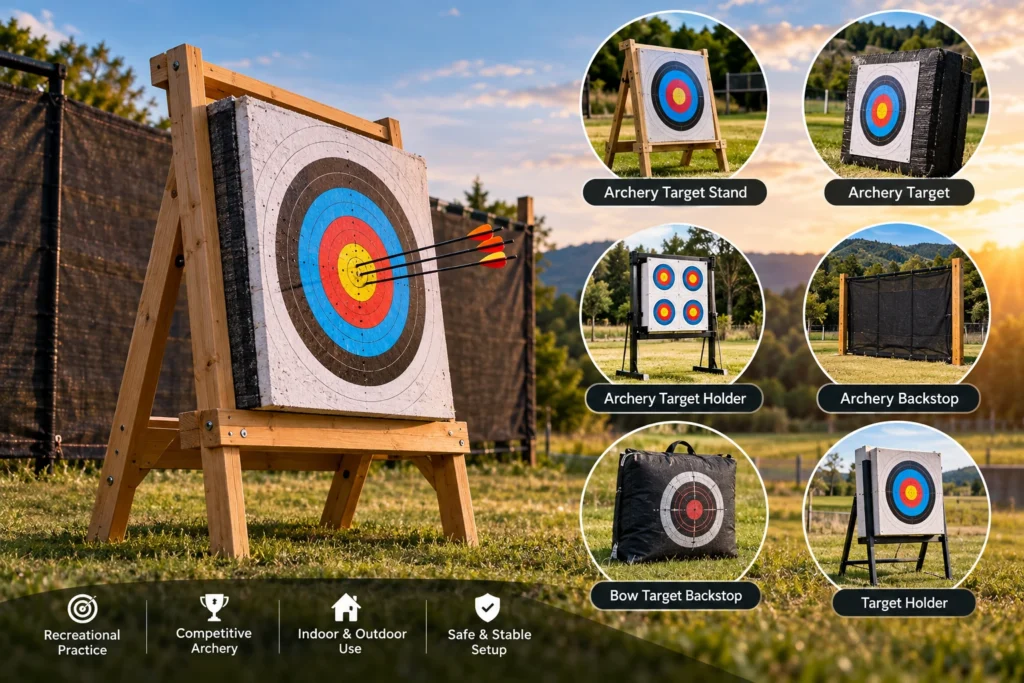
Archery has developed from a traditional hunting and survival skill into a popular recreational activity and an internationally recognised sport. Today, people practise archery in dedicated clubs, outdoor ranges, indoor facilities, schools, and private practice areas. Although bows and arrows receive much of the attention, the equipment placed at the other end of the shooting line is equally important. Targets, stands, holders, and backstops all contribute to the overall practice environment.
An Archery Target Stand is an important part of this equipment arrangement. It supports the target, helps maintain its position, and allows archers to practise with a more consistent setup. The target itself needs to remain stable, visible, and suitable for the distance and type of archery being practised.
As modern archery continues to include different bow styles, target formats, and shooting environments, the relationship between targets and their supporting equipment has become increasingly important. Understanding how these elements work together provides a clearer picture of the equipment and preparation involved in recreational and competitive archery.
Why the Target Setup Matters in Archery
Archery practice depends on repetition. An archer shoots, observes the arrow’s position, makes adjustments, and repeats the process. For this process to be useful, the target should remain in a consistent position throughout the session.
A target that moves, leans, or falls after repeated shots can interrupt practice. It may also make it difficult to compare shooting results from one round to another. A stable support system helps reduce these interruptions and creates a more predictable shooting environment.
The target itself also needs to suit the activity. Beginners may use larger practice targets, while experienced archers often work with specific target faces and scoring zones. Competitive archery follows defined formats, including different target dimensions and shooting distances.
The supporting equipment must therefore work with the target rather than being treated as an unrelated accessory. A suitable target holder or stand helps keep the target correctly positioned and makes the practice area easier to manage. The stability of the complete arrangement can influence how smoothly a practice session operates.
How Target Stands Support Different Shooting Environments
Archery does not take place in only one type of location. A club may have a permanent outdoor range, while a recreational archer may use a temporary practice area. Indoor facilities have their own space limitations, and field archery involves shooting across a course with targets positioned at different locations.
These environments create different requirements for target support.
A permanent outdoor range may use heavy target butts or fixed support structures. These arrangements are intended to remain in place for regular sessions. A temporary practice area, on the other hand, may benefit from a portable archery target stand that can be moved and stored when it is not being used.
Indoor facilities generally need equipment that fits within a controlled space. The target must be positioned correctly without creating unnecessary obstacles around the shooting line. Field archery has a different arrangement because targets are distributed across a course rather than placed along one straight line.
The main purpose remains consistent across these environments: the target needs reliable support, and the surrounding area must be appropriate for the type of shooting taking place. Equipment intended for one environment may not be suitable for another, which makes the shooting location an important part of the overall setup.
Portable support equipment is also relevant for archers who need to move their practice equipment between locations. A folding structure can make transportation and storage more convenient, provided its design and weight capacity are suitable for the target being used. For example, a 4-leg archery target foldable stand represents a portable support option for an archery practice setup.
Different Target Formats and Their Supporting Equipment
Archery targets are available in several formats. Some are designed for repeated recreational practice, while others follow formal competition specifications. Their size, construction, and intended use influence the type of support required.
Foam Targets
Foam targets are commonly used for practice because they are available in different shapes and sizes. Their construction is intended to receive arrows and allow them to be removed. The target needs a suitable support surface that keeps it upright and positioned correctly.
Layered Foam Targets
Layered foam targets use compressed material arranged in layers. Their structure is designed to provide an arrow-stopping surface, although performance depends on the specific product and its intended use. The supporting frame should be compatible with the target’s dimensions and weight.
Bag Targets
Bag targets are another familiar option. They are often used for recreational shooting and may have a large visible aiming area. Their shape and weight distribution can affect how they sit on a stand or holder. Proper positioning helps keep the target in place during regular practice.
Competition Targets and Target Butts
Traditional target butts and competition targets are used in more organised shooting environments. These may require a dedicated support arrangement, particularly when the target is part of a formal range layout. The target face, backing material, and supporting structure need to work together as one arrangement.
A Bow Target Backstop is also an important part of many practice setups. It provides an additional protective layer behind the target where the range design and safety requirements call for one. A backstop should never be treated as a substitute for a properly designed shooting range or a safe shooting direction.
Comparison of Common Archery Target Setups
Different target formats serve different purposes. The following comparison highlights common arrangements and explains how their supporting equipment contributes to the practice environment.
| Target Setup | Common Use | Supporting Arrangement | Main Consideration |
|---|---|---|---|
| Foam Target | Recreational and regular practice | Compatible frame or target stand | Stable support and suitable target dimensions |
| Layered Foam Target | Repeated practice | Firm stand or target butt | Target weight and secure positioning |
| Bag Target | Casual and recreational shooting | Suitable holder or frame | Shape, weight distribution, and stability |
| Competition Target Face | Organised target archery | Regulation-compatible target butt | Official target dimensions and positioning |
| Field Archery Target | Outdoor course shooting | Course-specific target support | Terrain, shooting direction, and safe access |
The comparison shows that there is no single support arrangement for every target. The correct setup depends on the target format, the shooting environment, and the requirements of the activity. A stand designed for a small practice target may not provide suitable support for a larger or heavier target.
What Official Archery Target Dimensions Tell Us
Competition specifications provide a useful way to understand why target size matters. World Archery describes different target face dimensions for different disciplines and shooting formats.
For example, international outdoor recurve archers shoot at a 122 cm target face from 70 metres. Compound archers shoot at an 80 cm target face from 50 metres. In international indoor target archery, recurve archers use a 40 cm target face at 18 metres.
These specifications demonstrate that target dimensions are connected to the format of the sport. A target stand or supporting structure must accommodate the target being used and maintain its intended position.
The following table compares three official target face diameters used in recognised target archery formats. It provides a clear numerical comparison of target dimensions and shooting distances.
| Archery Format | Shooting Distance | Target Face Diameter |
|---|---|---|
| Outdoor Recurve | 70 metres | 122 cm |
| Outdoor Compound | 50 metres | 80 cm |
| Indoor Target Recurve | 18 metres | 40 cm |
Target Diameter Measurement Reference
| Measurement Point | Diameter in Centimetres |
|---|---|
| Point 1 | 0 cm |
| Point 2 | 30 cm |
| Point 3 | 60 cm |
| Point 4 | 90 cm |
| Point 5 | 122 cm |
The measurements make it easier to compare target sizes using a consistent centimetre scale. The 122 cm outdoor recurve target is the largest of the three formats shown, while the 40 cm indoor target is the smallest. These figures describe target face diameters, not stand dimensions or target difficulty.
The Importance of an Archery Backstop
A target is only one part of a shooting area. The space behind it also needs attention. An archery backstop is used in suitable range arrangements to help stop arrows that pass beyond or miss the target.
The design of a backstop depends on the equipment, shooting distance, arrow type, and environment. Different materials may be used, but no material should automatically be assumed to stop every arrow. The backstop must be appropriate for the actual shooting conditions.
A Bow Target Backstop can be particularly relevant in practice areas where additional arrow containment is required. However, a backstop does not make an unsafe shooting direction acceptable. The entire shooting lane must be planned so that people, animals, buildings, roads, and neighbouring properties are not exposed to stray arrows.
The target, stand, and backstop should be considered together. If one part of the arrangement is unsuitable, the overall setup may not provide the expected level of stability or protection. This is why range planning and suitable equipment should always be considered before shooting begins.
Target Holders and the Practical Side of Regular Practice
A target holder may appear to be a simple piece of equipment, but its role becomes clear during repeated shooting sessions. It keeps the target in a defined position and helps prevent unnecessary movement.
The term target holder can refer to different types of support equipment. Some holders are designed for specific target shapes, while others are part of a larger frame or stand. Their construction and capacity vary, so compatibility matters.
An Archery Target Holder should match the target’s dimensions and weight. A holder that is too small may not support the target properly, while an unsuitable frame may allow movement during use. The ground surface also matters. A stand placed on uneven or unstable ground may not remain upright.
Portable support systems are useful where equipment needs to be moved between locations. Fixed structures may be more appropriate for permanent ranges. In either case, the equipment should be inspected regularly for loose connections, damaged components, corrosion, and signs of wear.
How Target Standards Influence Stand Design
The relationship between target dimensions and support design becomes especially clear in organised archery. A target face has a defined diameter, but the complete target arrangement also includes the backing material and the structure holding it in position.
World Archery’s outdoor target formats include 122 cm and 80 cm faces, while indoor target formats include 60 cm and 40 cm faces. These sizes are not interchangeable details. They form part of the official competition arrangements.
For equipment manufacturers, this creates a practical design consideration. A stand intended for a large target needs to accommodate its dimensions and weight. A smaller indoor target may require a different support arrangement, especially where multiple target faces are positioned together.
The term Archery Target and Stand therefore describes more than two separate products placed next to each other. It represents a working arrangement in which the target and its support need to be compatible. Their dimensions, construction, and intended use all contribute to how the complete setup performs.
The Role of Target Equipment in Recreational Archery
Recreational archery has grown beyond traditional club environments. People participate through organised groups, outdoor activities, training sessions, and personal practice. This variety means that target equipment is used in many different ways.
A beginner may focus on learning basic shooting technique and developing consistency. A more experienced archer may practise at measured distances or prepare for a competition. A club may need equipment that can be used by several people during scheduled sessions.
These different situations influence the type of target and support system required. A portable setup may be practical for one location, while a permanent target structure may be more suitable for another. Indoor practice also brings space considerations that are different from those of an outdoor range.
The important point is that equipment should be selected and arranged according to the actual activity. A target stand is not simply a display frame. It is part of the shooting environment and should contribute to a stable and organised practice area.
Maintaining a Consistent and Responsible Practice Area
Regular equipment checks help keep an archery practice area organised. Before shooting begins, the target should be inspected for damage and positioned securely. The stand should be checked for movement, loose fittings, or other visible problems.
The area behind and around the target also needs attention. Archers should use a designated shooting area with a clear range layout and an appropriate backstop where required. No one should move forward to collect arrows until all shooting has stopped and the range has been declared safe.
Targets should be used within their intended limits. A target designed for one type of arrow or bow may not be suitable for another. Following the manufacturer’s instructions helps reduce unnecessary wear and equipment problems.
Storage also matters. Outdoor equipment exposed to moisture, sunlight, and changing temperatures may deteriorate over time. Keeping equipment in suitable storage conditions can help extend its usable life. Stands and holders should also be checked before being returned to use after storage.
Why the Complete Setup Deserves Attention
Archery is often discussed in terms of bows, arrows, draw weight, and shooting technique. These are important parts of the sport, but the target area deserves equal consideration. The target provides the aiming surface, the stand or holder keeps it in position, and the backstop contributes to the wider safety arrangement.
A well-planned setup supports consistent practice across different environments. It also makes it easier to organise equipment for recreational sessions, club activities, and formal target archery. Understanding the differences between target formats and their supporting structures helps archers appreciate the role each component plays.
As archery continues to bring together traditional techniques and modern equipment, the supporting structures behind the target remain an essential part of the experience. The relationship between an Archery Target Stand, the target itself, and the surrounding practice area is what turns individual pieces of equipment into a functional shooting setup.