

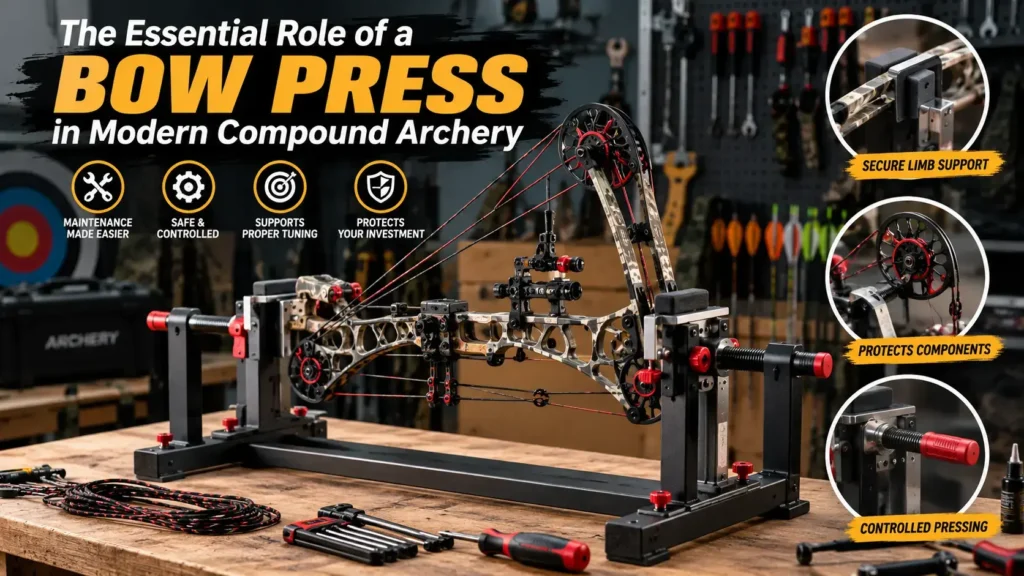
The Essential Role of a Bow Press in Modern Compound Archery
A bow press is an important piece of equipment in modern compound archery. It provides controlled support for a compound bow when certain maintenance, inspection, and tuning procedures require the tension in its string and cable system to be reduced. Although it may look like a straightforward workshop tool, its design and compatibility matter because compound bows store considerable energy and contain several interconnected mechanical components. As compound-bow technology has developed, bow designs have become increasingly varied. Limb geometry, cam configurations, axle positions, and cable arrangements can differ between models. These differences have also influenced the development of bow presses, making compatibility an important consideration for archers, technicians, and professional archery workshops. For anyone who regularly works with bows, understanding the role of a bow press provides useful context for equipment maintenance. It also explains why choosing an appropriate press is not simply a matter of selecting a tool that appears strong enough. The press must support the bow according to its design and the manufacturer’s instructions.
Understanding the Purpose of a Bow Press
A bow press is specialised equipment designed primarily for compound-bow maintenance. It applies controlled pressure to the appropriate areas of a bow’s limbs, allowing the tension in the bow system to be reduced when a particular service procedure requires it. Compound bows use a combination of limbs, cams, axles, cables, and a bowstring to produce their mechanical performance. These components work together under tension. As a result, certain maintenance tasks cannot be approached in the same way as adjustments to ordinary sporting equipment. A suitable bow press can provide technicians with the access and support needed for specific workshop procedures. Depending on the bow’s design and manufacturer requirements, these procedures may involve inspecting or replacing strings and cables, carrying out certain tuning work, or servicing components that remain under tension during normal use. It is important to understand that a bow press is not a universal repair tool. Different compound bows may require different pressing arrangements, and some models have specific manufacturer-approved procedures. The correct equipment and instructions should always be confirmed before any pressing work begins.
Why Modern Compound Bows Require Specialised Equipment
Modern compound bows are engineered systems rather than simple flexible frames. Their performance depends on the relationship between the limbs, cams, axles, cables, and string. Each component has a particular function, and changes to one part can affect the operation of the complete bow. One important development in compound-bow design has been the variation in limb geometry. Older and newer bows may have noticeably different limb angles, spacing, and configurations. A pressing arrangement that works with one design should not automatically be assumed suitable for another. This development explains why modern bow presses are available in different configurations. Some are designed for particular bow geometries, while others offer adjustment options for a wider range of compatible models. However, a broad adjustment range does not mean that a press is automatically compatible with every bow. For archers and technicians, the practical consideration is straightforward: identify the exact bow model, consult its manufacturer guidance, and select equipment approved for that configuration.
How a Bow Press Supports Bow Maintenance
The main function of a bow press is to provide controlled support when a maintenance procedure requires tension to be reduced. This can be particularly relevant when working around the bowstring, cables, cams, and other components that form part of the compound-bow system. For example, an archer may notice wear around a serving area or identify damage that requires professional inspection. A technician may need to assess the condition of a bow string, examine cable components, or carry out an approved replacement procedure. A compatible press can form part of the equipment used to complete that work. However, the press does not replace technical knowledge. The person carrying out the maintenance must understand the bow’s construction, the manufacturer’s requirements, and the correct procedure for the particular model. Applying pressure without that knowledge can introduce unnecessary risks.
Why Limb Contact Points Matter
Correct contact points are among the most important considerations in bow-press design. A press must support the bow in the areas intended by its design rather than applying force to unrelated structural or mechanical components. Compound-bow limbs are designed to flex in a particular manner during the draw cycle. A suitable pressing system should work with the bow’s intended geometry. Incorrect positioning can create unwanted leverage or place stress on areas that are not intended to receive that pressure. This is especially important when working with bows that have parallel or highly angled limb configurations. A press that was suitable for an older compound-bow design may not be appropriate for a newer model. Technicians should also avoid unintended contact with sensitive components such as cams, axles, cables, and string sections. The correct contact arrangement depends on the bow and the press being used, so manufacturer instructions should take priority over generic advice. Archers looking for purpose-built manual equipment can also explore the Last Chance Archery EZ Green Manual Bow Press. Before selecting a bow press, review the product details and confirm compatibility with the specific compound bow. Choosing suitable equipment is an important part of responsible bow maintenance and servicing.
Different Types of Bow Presses
Bow presses are available in several configurations to accommodate different workshop environments and compound-bow designs. Their differences generally relate to construction, adjustment, portability, and intended use.
Linear Bow Presses
Linear bow presses use a relatively direct movement to apply controlled pressure through their supporting mechanism. Their operating concept is straightforward, and particular designs may be suitable for a range of compound bows when the manufacturer’s compatibility requirements are met. These presses can be considered by archery workshops and experienced users who need equipment for specific compatible bow configurations. However, the term linear describes a press design; it does not establish universal compatibility.
Portable Bow Presses
Portable bow presses are designed for users who need a more mobile maintenance setup. Their compact construction can be useful for archers who travel, hunt, or work in locations where a permanent workshop is not available. Portability can make equipment easier to transport and store, but it should not be the main factor in choosing a press. Stability, compatibility, construction quality, and manufacturer approval remain essential considerations.
Shop-Grade Bow Presses
Shop-grade bow presses are intended for professional archery environments where equipment may be used regularly. An archery shop can service multiple bow models, so the ability to accommodate different approved configurations can be valuable. Depending on the design, professional systems may offer adjustment options and construction intended for repeated workshop use. Their suitability should still be evaluated against the specific bows that the technician expects to service.
Bow Press Types Compared
The following table provides a practical comparison of common bow-press categories. It focuses on their general characteristics and typical workshop applications rather than assigning unsupported performance scores. Actual compatibility depends on the individual press model and the bow manufacturer’s instructions.
| Bow Press Type | General Design | Typical Application | Important Consideration |
|---|---|---|---|
| Linear Bow Press | Uses a relatively direct pressing movement | Suitable workshop maintenance for compatible compound bows | Confirm the approved contact arrangement and bow compatibility |
| Portable Bow Press | Compact design intended for easier transport | Mobile maintenance setups and situations away from a permanent workshop | Check stability, adjustment range, and manufacturer approval |
| Shop-Grade Bow Press | Workshop-oriented construction, sometimes with broader adjustment options | Regular servicing of compatible bows in professional archery shops | Verify compatibility for every bow model being serviced |
Visual Comparison of Bow Press Categories
The graphic below presents a qualitative comparison of the three common bow-press categories. It illustrates their general positioning in terms of portability, workshop orientation, and typical use. These are descriptive categories, not laboratory measurements or independently verified numerical ratings.
Bow Presses and Bow String Maintenance
The relationship between a bow press and a bow string is an important part of compound-bow maintenance. Strings and cables experience repeated loading during normal shooting, and their condition can affect the operation of the complete bow system. Over time, archers may notice wear, fraying, serving damage, or other changes that require inspection. Regular visual checks can help identify problems early, although a qualified technician should assess damage that may affect the safety or performance of the bow. The terms bowstring and archery string are also commonly used when discussing string systems, replacement components, and archery equipment. Regardless of the terminology, choosing a compatible replacement is essential. The correct string must meet the specifications for the particular bow rather than simply appearing to fit. When a string or cable replacement procedure requires the bow to be pressed, the technician should use an approved press and follow the relevant instructions. A bow press can support the procedure, but it does not independently establish whether a particular string, cable, or maintenance method is suitable.
Common Mistakes When Using a Bow Press
Bow-press mistakes can affect both equipment condition and user safety. Understanding the most common problems helps explain why compatibility and correct procedures are so important.
- Choosing an incompatible press: A press should never be selected based only on appearance or general claims. Verify compatibility with the exact bow model.
- Using incorrect contact points: Pressure should be applied only at the intended support locations.
- Allowing unwanted component contact: The press should not create unintended pressure on cams, cables, axles, or other sensitive areas.
- Applying pressure without control: The approved procedure should be followed carefully. Forcing a mechanism is not a substitute for correct adjustment.
- Ignoring alignment: Incorrect positioning can introduce unwanted forces into the bow system.
- Relying on improvised equipment: Ordinary clamps or homemade arrangements are not substitutes for a suitable archery-specific press.
- Ignoring manufacturer guidance: General information should never override the instructions for the specific bow and press.
These considerations are particularly relevant for modern compound bows, where different limb and cam configurations may require different support arrangements. When there is uncertainty, the safer option is to stop and consult a qualified archery technician.
How to Select the Right Bow Press
Selecting a bow press should begin with the compound bow that needs servicing. Before comparing products, identify the exact bow model and review the manufacturer’s maintenance requirements. This helps establish which pressing systems are approved or suitable for that equipment. After confirming compatibility, consider how the press will be used. An archer who needs occasional maintenance support may have different requirements from a professional technician who works with several bow models every day. Important selection factors include:
- Compatibility with the exact compound-bow model
- Support for the bow’s limb configuration
- Manufacturer-approved contact points
- Adjustment range and operating mechanism
- Construction quality and stability
- Ease of controlled adjustment
- Portability and storage requirements
- Availability of compatible accessories or replacement components
- Manufacturer instructions and technical support
Price is also worth considering, but it should not be the only deciding factor. A bow press is used around equipment that stores considerable energy. Reliable construction, suitable compatibility, and clear operating instructions are more important than choosing a product simply because it is inexpensive.
Home Bow Maintenance or Professional Archery Workshop?
Some experienced archers prefer to maintain their equipment at home. A properly equipped workspace can make certain maintenance tasks more convenient, provided that the user understands the bow and follows the manufacturer’s procedures. However, owning a bow press is not essential for every archer. Someone who only needs occasional string inspection or servicing may find it more practical to visit a qualified archery shop. Professional technicians have experience with different compound-bow configurations and access to appropriate workshop equipment. For professional archery shops, the requirements can be different. Regular servicing may make a suitable bow press an important part of the workshop setup. Equipment selection should reflect the range of bows being serviced, the frequency of use, and the manufacturer’s compatibility requirements. The decision should therefore be based on actual maintenance needs rather than the assumption that every compound-bow owner must have a press.
Why Build Quality and Compatibility Matter
A compound bow can represent a considerable investment. Its overall setup may include the bow itself, strings, cables, sights, arrow rests, stabilisers, arrows, and other accessories. Protecting this equipment requires appropriate maintenance practices and tools. A quality bow press can contribute to a more controlled workshop environment when it is suitable for the bow and used correctly. Its construction, adjustment mechanism, support arrangement, and stability all influence whether it is appropriate for the intended application. It is also important to distinguish between general build quality and actual compatibility. A well-constructed press is not necessarily suitable for every bow. The press must be approved for the particular model and used according to the relevant instructions.
Safety Considerations Before Pressing a Bow
Compound bows store substantial energy, so maintenance should always be approached carefully. A bow press is designed to support specific procedures, but using one does not remove every risk associated with servicing a compound bow. Before any pressing procedure, inspect the bow and the press for visible damage. Confirm that the equipment is compatible, that the bow is correctly positioned, and that the manufacturer’s instructions are understood. If a bow has cracked limbs, damaged components, unusual resistance, or any other condition that creates uncertainty, do not attempt to solve the problem by applying additional pressure. A qualified technician should inspect the equipment and determine the appropriate next step. Safety should take priority over convenience. The correct press, proper procedure, and knowledge of the bow’s construction must work together.
When Is a Bow Press Actually Needed?
A bow press is generally relevant when a particular maintenance or tuning procedure requires tension in the compound-bow system to be reduced. It is not required for every adjustment or routine inspection. Some basic external checks and cleaning tasks may be completed without pressing the bow. More involved work around strings, cables, cams, or other tensioned components may require specialised equipment and professional knowledge. The exact requirement depends on the bow’s design and the procedure being performed. Some modern compound bows have specific maintenance instructions, so archers should avoid assuming that a method used on one model will apply to another.
Purpose-Built Bow Presses Versus Improvised Solutions
For occasional users, an improvised solution may appear to be a convenient alternative to purchasing specialised equipment. However, compound bows are engineered systems that store significant energy, and makeshift pressing arrangements can introduce unpredictable forces. A purpose-built bow press is designed around archery equipment and provides a defined support arrangement. Even then, it must be compatible with the bow and operated according to its instructions. Purpose-built equipment should not be treated as automatically safe for every model. For archers who do not have suitable equipment or experience, using a qualified archery shop is a more responsible option than experimenting with homemade pressing methods.
Final Thoughts
A bow press plays an important role in modern compound archery because it provides controlled support for specific maintenance and tuning procedures. Its value comes from the way it works with the bow’s mechanical design, particularly when servicing strings, cables, and other components that operate under tension. Different press categories serve different workshop needs. Portable models prioritise mobility, linear designs use a particular pressing arrangement, and shop-grade systems are intended for professional workshop environments. None should be considered universally compatible without checking the specific bow and manufacturer’s instructions. For archers researching bows, bow string maintenance, bowstring replacement, or archery string care, understanding the role of a press provides useful equipment knowledge. The most important considerations remain compatibility, correct contact points, stability, construction quality, and safe operation. Ultimately, responsible compound-bow maintenance depends on using suitable equipment and following the correct procedure. A bow press can be a valuable part of that process, but technical knowledge and manufacturer guidance should always come first.